
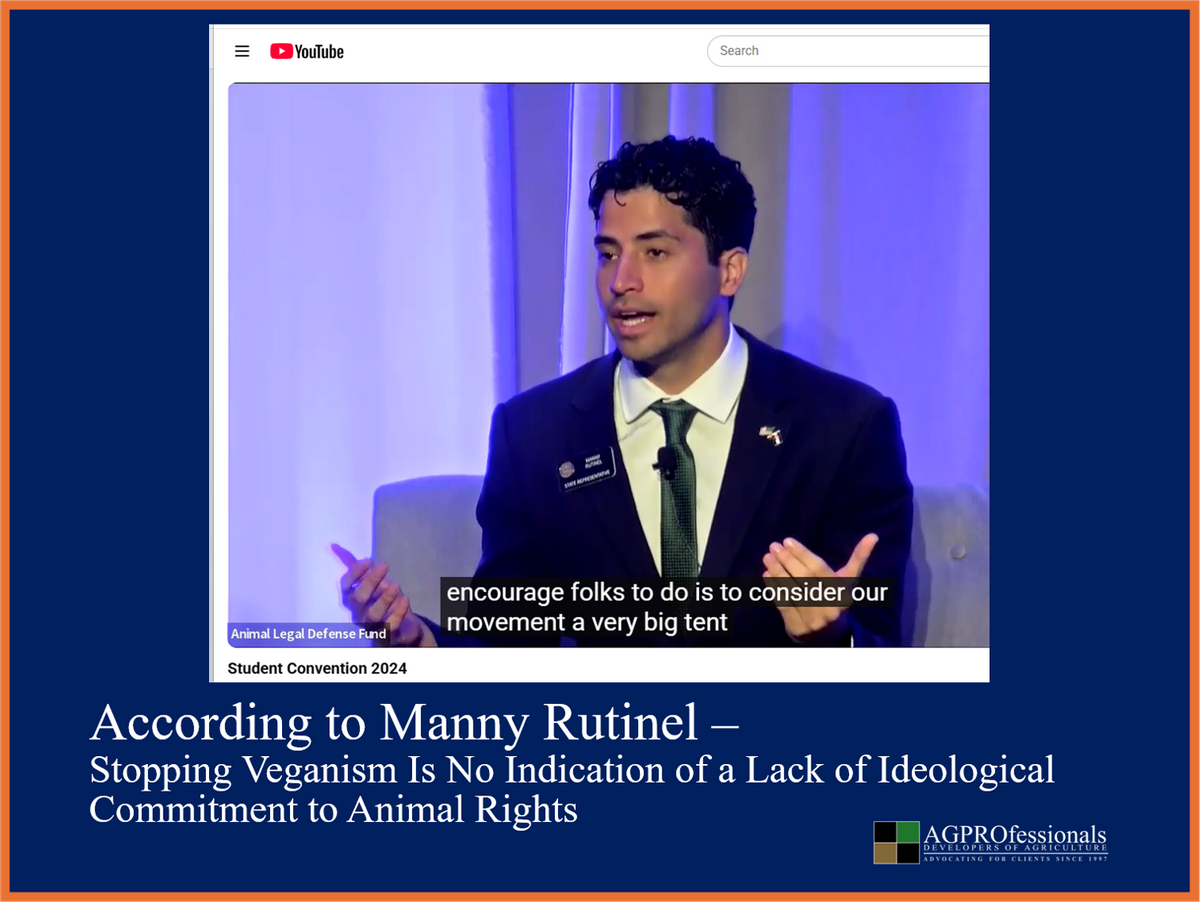
According to Manny Rutinel - Stopping Veganism Is No Indication of a Lack of Ideological Commitment to Animal Rights
When animal rights groups have been attempting to convert the public to a vegan lifestyle, much of the public discussion of animal rights activist groups has focused heavily on personal behavior. Activists distributed vegan literature, conducted online troll campaigns, protested, harassed customers of grocery stores, butcher shops, and restaurants, and promoted plant-based lifestyles as the primary means of reducing the use of animals in agriculture.
At the 2024 Animal Legal Defense Fund (ALDF) Student Convention, appointed Colorado State Representative Manny Rutinel described a different strategy. He said the “movement” was shifting away from an emphasis on individual changes and toward institutional action. In his view, legal requirements, ballot initiatives, legislation, corporate policies, government programs, and investment strategies could achieve dramatically greater results than persuading individuals to change their diets one at a time.
That distinction provides essential context for Rutinel’s recent statement that he is no longer vegan.
Rutinel Promoted Organized Influence as the Most Effective Approach to Implement Animal Rights Ideological Agenda
During the ALDF convention, Rutinel criticized veganism as a purity test within the animal movement. People hold complicated and sometimes competing beliefs, he explained, and very few people are truly vegan. Rutinel argued for a “very big tent” that would allow people to contribute without adopting a vegan diet. Suggested activities included donating money, joining protests, attending movement gatherings, and contacting legislators. He went so far as to say he would rather have a person donate $300 each year to an organization such as Animal Outlook than become vegan without publicly discussing animal agriculture or contributing to movement activity. The implication was clear: personal consumption mattered less than organized influence.
Rutinel Asserted the Future of Animal Law Should Shift Toward Institutional Action
When discussing the future of animal law, Rutinel said he saw the movement shifting toward institutional action rather than individual change. He recalled adopting the animal rights ideological agenda during a period when vegan leafleting was common. By 2024, he said, more of the movement’s thinking and resources were being directed toward institutional strategies because pilot programs had demonstrated their power. His primary example was California’s Proposition 12, which aims to cripple animal agriculture via compliance with regulations and driving up costs of animal products to consumers across the nation. California Prop 12 was promoted and marketed by animal rights activist groups.
Proposition 12 as a Model
Proposition 12 restricts the sale in California of pork, eggs, and veal produced under conditions that do not meet California’s housing requirements, including products from outside the state. Rutinel used the measure to illustrate the difference between consumer behavior and political action. He said that only a small percentage of California eggs were cage-free before the ballot measure, yet a much larger percentage of voters supported imposing cage-free requirements through law.
He characterized this as a difference between the consumer mindset and the citizen mindset. Consumers might continue purchasing conventional products when making individual decisions at a store. The same people, acting as voters, might support a legal requirement compelling the entire market to change.
Rutinel said advocates should identify and use these institutional leverage points because the resulting impact could be tenfold, hundredfold, or a thousandfold greater than individualized action.
Using State Victories to Influence Other States
Rutinel also discussed how animal rights ballot victories could influence policy beyond the state where they initially passed. He cited California Prop 12 and Massachusetts Question 3 as major successes. According to him, activists could take a decisive victory in one state and use it to pressure lawmakers elsewhere. In short, they advocate targeting vulnerable states that lack strong industry support or have little or no agricultural production to set a precedent. Massachusetts Question 3 is a prime example, as the state has few agricultural producers.
The strategy is to tell legislators that opponents might have to spend millions of dollars fighting a ballot measure likely to pass and then offer additional implementation time in exchange for lawmakers moving a similar proposal through the legislative process. Rutinel believes the broader public was “very much in favor of animal rights,” but that this preference was not adequately reflected in legislatures. He attributed the disparity partly to agricultural committees influenced by rural lawmakers and what he called “entrenched farm interests.”
Carbon Markets as Institutional Action
Rutinel’s Yale farm-transition proposal reflected the same philosophy. Rather than relying on consumers to voluntarily purchase fewer animal products, the proposal sought to use carbon markets to influence producers’ economic decisions. Carbon-offset funding would make plant production more financially attractive than raising livestock. The objective was to pay farmers to replace animal operations with plant-based businesses. Rutinel hoped the concept would first be accepted by voluntary carbon registries and later incorporated into government compliance markets.
The mechanism differed from Proposition 12, but the underlying strategy was similar. Change the institution, the economic incentive, or the governing rule, and individual choices will follow.
Why “I’m No Longer Vegan” Does Not Resolve the Policy Question
In July 2026, Rutinel told The Colorado Sun that he had not been vegan for several years and now eats meat. He also said he no longer holds the animal liberation views expressed in his early Reddit posts.
However, his own remarks from 2024 show why they do not answer the larger policy question. Rutinel explicitly said veganism should not determine whether someone belongs in the animal rights movement. He argued that institutional action could accomplish far more than individual dietary change. Therefore, the claim that Rutinel now eats meat does not establish whether he has abandoned the institutional strategies he promoted.
Does he still support Proposition 12 as a model? Does he still favor using ballot initiatives to create production standards that extend beyond state borders? Does he still support carbon market incentives to replace livestock operations? Does he still believe animal rights activists should prioritize legal and political power over individual consumer persuasion?
Those are the questions that matter to producers whose businesses, property, and communities could be greatly harmed by the policies we believe he will pursue, based on his past history.