
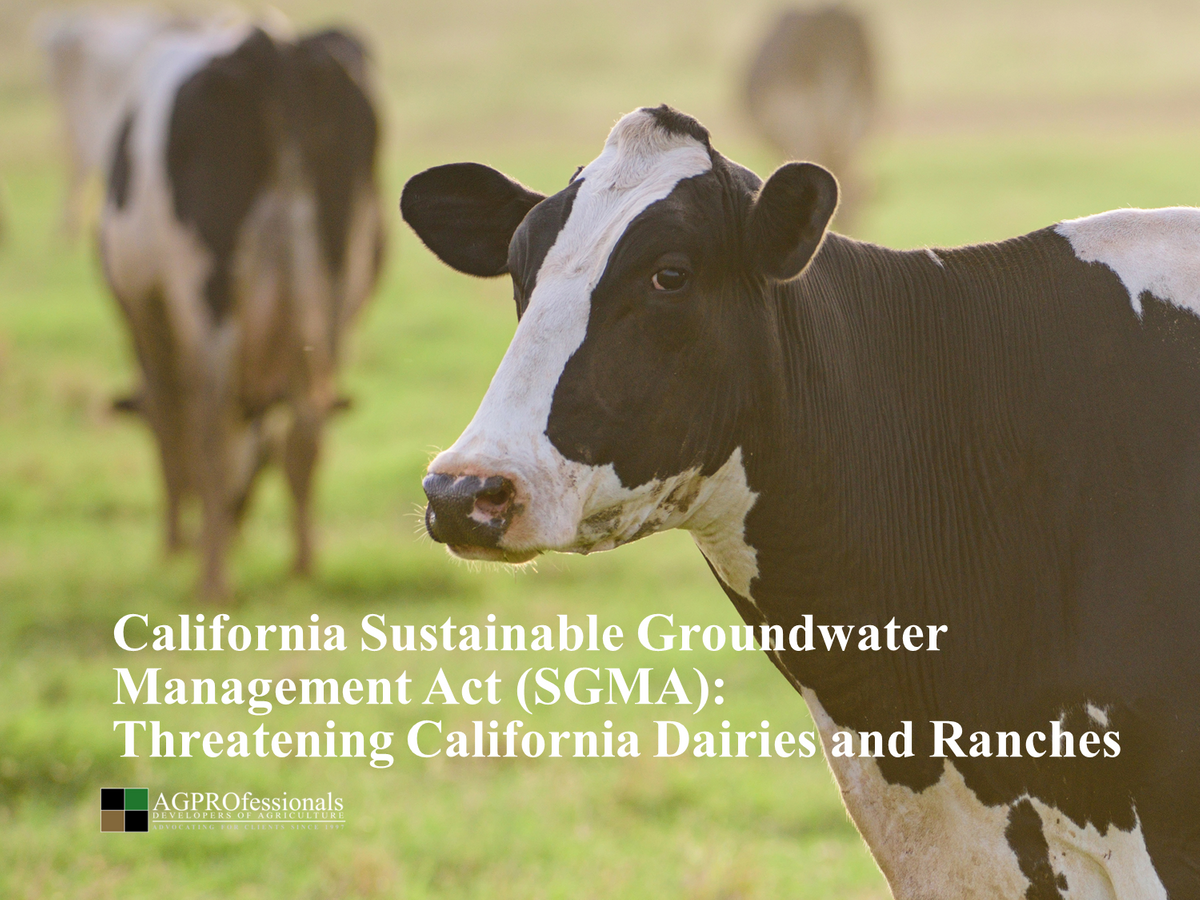
Who is Influencing the California Sustainable Groundwater Management Act (SGMA): Threatening California Dairies and Ranches
A New Era of Water Regulation in California Agriculture
California agriculture has always relied on one key resource: water. Groundwater has long provided a dependable, relatively affordable foundation for dairy and ranching operations across the state, especially in the Central Valley. The passage of the Sustainable Groundwater Management Act (SGMA) in 2014 marked a significant turning point. Enacted through a series of legislative measures, including AB 1739, SB 1168, and SB 1319, SGMA established a statewide requirement to achieve "sustainable" groundwater basins by 2040–2042. While framed as a long-term environmental safeguard, its practical effects are now evident in severe costs, reduced water access, and considerable operational uncertainty for farmers and ranchers. SGMA is not merely an additional regulation layered onto an already complex system. The most disturbing aspect of these changes is that outside non-governmental organizations (NGOs) have been given substantial influence over how water is managed. It signifies a structural change in how agriculture functions in California and, in many cases, whether it can continue to operate at all.
What SGMA Actually Does: It Is Not About Lack of Water
An important, and often misunderstood, aspect of SGMA is that it is not fundamentally about a lack of water. California has substantial groundwater reserves. The issue is not that the water is gone, but that it is now regulated, measured, and priced. Producers are no longer operating in a system where water availability is primarily dictated by weather or infrastructure. Instead, water access is now determined by regulatory allocation, compliance requirements, and escalating costs. As industry analysis has noted, groundwater in California didn’t disappear; it simply “got an invoice.”
Agriculture is No Longer a Key Stakeholder
SGMA is a system where groundwater is managed by locally formed Groundwater Sustainability Agencies (GSAs). These agencies are responsible for managing water at the basin level and developing Groundwater Sustainability Plans (GSPs) to achieve sustainability goals. If these plans are inadequate, the State Water Resources Control Board can intervene, increase oversight, and impose new fees.
SGMA has essentially shifted influence over water policy by requiring GSAs to include input from a wide range of “stakeholders,” including environmental and community groups. In practice, this results in a layered system where outside organizations, not true stakeholders, participate directly in shaping groundwater policies. These committees are active, providing input on GSPs that set pumping limits, compliance strategies, and costs.
This system, involving external environmental NGOs, positions agriculture as just one stakeholder among many. As a result, a conflict may arise between the needs of local farmers and the ideological aims of NGOs that do not rely on agriculture for their livelihoods. This change is important because the policymakers are not the ones who will be affected if their rules impede or block operational viability.
A Policy Shift Influenced by NGOs
In Tulare County’s Kaweah basin, one of the country’s most important dairy regions, public records show that individuals affiliated with organizations such as Self-Help Enterprises, Community Water Center, Leadership Counsel, and Sequoia Riverlands Trust hold seats on GSA advisory committees.
In Kings County’s Tulare Lake subbasin, the role of outside organizations appears different but is no less significant. During the State Water Resources Control Board’s intervention process, triggered when local plans were deemed inadequate, the state documented working with organizations including Community Water Center, Clean Water Action, Self-Help Enterprises, and Leadership Counsel on outreach and engagement. Some of these same organizations publicly supported the state’s probation designation, which opened the door to additional fees and regulatory oversight.
This is how outside NGOs influence SGMA. Not always through votes, but through the process that defines the rules.
NGO Agendas: Beyond the Names
While the passage of SGMA marked a significant turning point, what is happening to farmers and ranchers in California is part of a well-established pattern of egregious anti-agriculture activities in the state, driven by non-governmental organizations (NGOs). Many of the NGOs involved have names that obscure their true agenda and the ideological beliefs of their board members. These national and California-based environmental NGOs have long focused on livestock production as a target through litigation, regulatory petitions, and public campaigns. Their efforts have consistently sought to impose tighter constraints on animal agriculture.
That history matters because those same policy priorities are now intersecting with groundwater policy in California. The outcomes of SGMA align closely with long-standing policy goals advocated by many of these environmental organizations. Those goals include:
• Reducing agricultural water use
• Repurposing farmland
• Increasing environmental water allocations
The affiliations and statements of the groups involved with GSAs reveal their ideological agenda. Listed below are some examples:
- The NRDC has openly described litigation as a key strategy for reshaping agricultural systems and has pursued lawsuits tied directly to livestock production practices.
- Waterkeeper-affiliated groups have built entire campaigns to oppose concentrated animal feeding operations, often through water-quality litigation and regulatory pressure. California Coast Keeper Alliance vowed in 2025 to “…watchdog the government’s approval of Groundwater Sustainability Plans” and to redefine California water law, vying to eliminate the traditional “first in line, first in use” policy.
- The Community Water Center has an entire section of its website dedicated to limiting animal agriculture. Community Water Center board members have affiliations and past connections with groups like Environmental Justice Coalition for Water and Earth Justice.
- Sierra Club actively campaigns against large modern farms and, over the years, has made false claims about their impact on climate change. The Sierra Club policy page states, “…minimizing the production and consumption of domestic animals that produce the most methane is one critical way to reduce greenhouse gas production.”
- On its website, the Leadership Council for Justice and Accountability states that it focuses on dairies and has actively opposed dairy expansions.
- Sequioa Riverlands Trust (SRT) participates in five GSAs in a “stakeholder or advisory capacity and is currently providing input on their draft GSPs.”, according to the Cleanwater.org website. SRT believes that “Bringing our region’s groundwater use in line with sustainable supplies is likely to involve significant changes in land use, however, with recent estimates indicating that 500,000 acres of irrigated cropland could be taken out of production.”
Stacked Fees: How SGMA Is Disrupting Dairy Economics
The financial pressure created by SGMA stems from multiple layers of fees that together create a substantial burden. Producers are not facing a single charge but rather a stacking of state and local costs.
In basins placed on probation by the state, dairies face direct state-imposed fees, including annual per-well charges and volumetric fees based on water extraction. These can reach $20–$25 per acre-foot, plus additional compliance costs and penalties. At the same time, local GSAs impose their own fees, which vary significantly by region. These may include per-acre assessments, pumping fees, and steep penalties for exceeding allocated water limits. In some areas, these local charges alone can approach or exceed $95 per acre-foot, with overuse penalties climbing as high as $500 per acre-foot.
When these layers are combined, operating costs rise dramatically. For example, a typical 3,000-cow dairy, that is also growing alfalfa and pumping approximately 6,000 acre-feet of water annually, SGMA-related fees can translate into $80 to $190 per cow per year. In some regions, when accounting for both fees and infrastructure, total water-related costs can exceed $200 per cow annually. This amounts to an additional annual expense for the dairy farmer of $240,000 to $600,000, respectively. This level of additional expense is egregious and directly erodes already tight margins.
Reduction in Irrigated Acreage and Altered Land Values
SGMA is altering land values and long-term planning. Water restrictions are forcing reductions in irrigated acreage. Dairies that once grew a significant share of their own feed are now being pushed to fallow land or cut production. That lost feed must be replaced on the open market, often at a higher cost. The result is a compounding effect: rising water costs paired with rising feed costs.
Land without reliable water access becomes less productive and therefore less valuable. At the same time, operations must plan for major capital investments, such as deeper wells or alternative land uses, to remain viable.
The Overlooked Impact on Ranchers
While dairies are often at the center of the SGMA conversation, ranchers face their own set of challenges, many of which are less visible but equally significant. One of the most immediate impacts is the introduction of new per-acre assessments tied to SGMA implementation. In some areas, ranchers are charged annual per-acre fees, regardless of whether they are actively pumping groundwater.
For large ranching operations, these costs add up quickly. A 2,000-acre ranch, for example, could incur an additional $2,000 in annual expenses from these assessments. Compounding the issue is that these fees are applied broadly, including grazing lands that may not rely heavily on groundwater. This creates a situation where ranchers pay into a system designed to regulate water use, even when their direct usage is minimal.
What This Means for California Agriculture Moving Forward
SGMA is a long-term restructuring of how agriculture operates in California. California has substantial groundwater resources, but under SGMA, access is now influenced by cost, regulation and compliance rather than availability alone. Water policy trends are reducing the share of water available for agricultural use, adding another layer of pressure on farming and ranching operations already dealing with challenges.
Water costs must now be treated as a central component of financial planning. Water is no longer an assumed resource; it is a controlled input with a defined cost and limited availability. Land value must be evaluated in the context of long-term water access. Strategic decisions, from expansion to relocation, must account for the regulatory environment. Increasing expenses pose a threat to long-term profitability for dairies, whereas ranchers experience more subtle but consistent effects from layered fees and reduced flexibility.
This reality is forcing producers to rethink everything from crop selection to herd size to geographic location. Marginal land is being taken out of production. Capital requirements are increasing. Adaptation is possible for certain operations, but for others, the economics may no longer be feasible.
The bottom line is that SGMA is being influenced by NGOs with an ideological agenda, often against agriculture, and they are altering water management, which determines who can afford to farm and ranch in California.
Links and References
California Department of Water Resources. Sustainable Groundwater Management Act (SGMA) Overview.
State Water Resources Control Board. Tulare Lake Subbasin Probationary Hearing Staff Report (Appendix C).
East Kaweah Groundwater Sustainability Agency. Board and Advisory Committee Listings.
Mid-Kaweah Groundwater Sustainability Agency. Advisory Committee Structure and Membership.
SJV Water. Kings County groundwater fee proposals and SGMA enforcement reporting.
Community Water Center. Press statements regarding Tulare Lake Subbasin probation.
Environmental Defense Fund. California groundwater management resources and policy materials.
Natural Resources Defense Council. Agricultural litigation and policy advocacy materials.
Earthjustice. Litigation related to antibiotic use in livestock production.
The Bullvine. “$190 Per Cow: The SGMA Water Cost Trap…” HERE and HERE
Sierra Club Shapes Groundwater Agency Formation HERE
The CLEAR Center - How Water is Managed in Western Dairies HERE
East Kaweah Welcomes New GSA Members HERE