
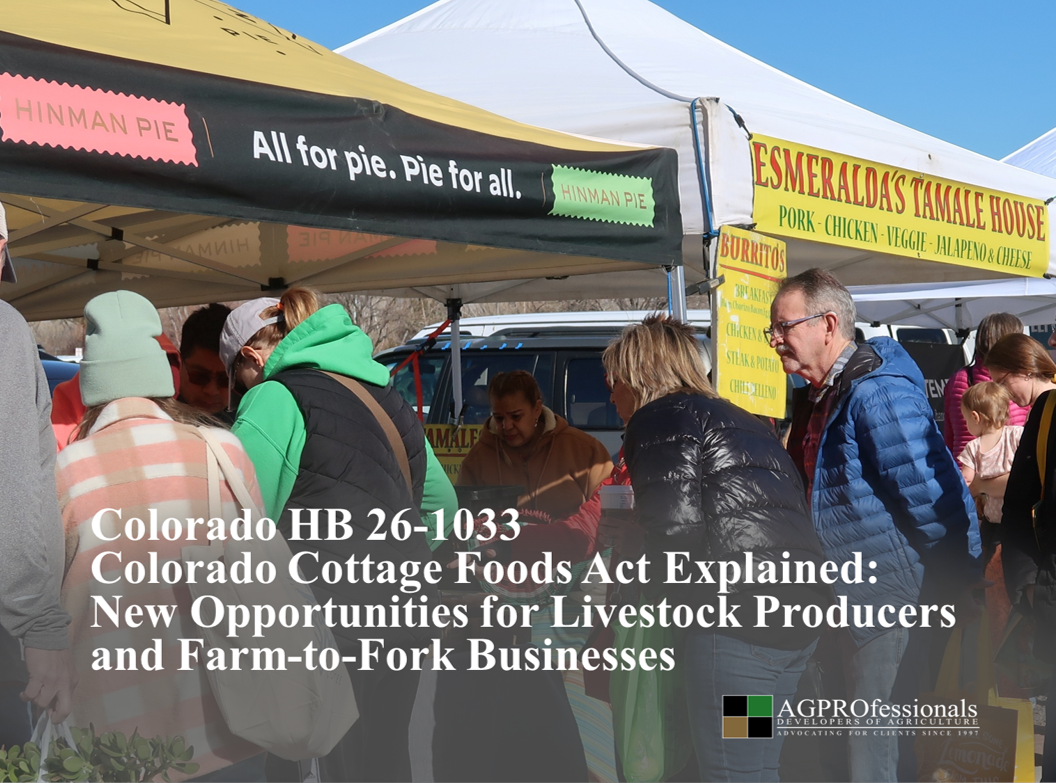
Colorado Cottage Foods Act Explained: New Opportunities for Livestock Producers and Farm-to-Fork Businesses
The Colorado Cottage Foods Act has long served as a gateway for small-scale food entrepreneurs to enter the marketplace. Often referred to as the “Tamale Act,” under House Bill 26-1033, it is expanding greatly. The amendments have been approved, and the bill is waiting for a signature from the Colorado Governor. These changes represent a shift toward greater opportunity, flexibility, and revenue potential for agricultural producers, particularly those in livestock and direct-to-consumer markets.
House Bill 26-1033 was introduced with broad legislative backing. This bipartisan support reflects growing recognition of the importance of local food systems and small-scale agricultural entrepreneurship in Colorado. The House and Senate Sponsors are Gonzalez, Duran, Caldwell, Lindsay, Martinez, Mauro, Nguyen, Richardson, Ricks, Rutinel, Winter, and Sens. Rodriguez and Pelton.
This article breaks down the updated Colorado Cottage Foods Act, explains its application to agricultural operations, and highlights why it matters to producers seeking to expand farm-to-fork business models.
What Is the Colorado Cottage Foods Act?
The Colorado Cottage Foods Act allows individuals to produce certain foods in a home kitchen and sell them directly to consumers without a commercial food manufacturing license. Historically, the law focused on non-potentially hazardous foods, such as baked goods, jams, spices, and honey, that do not require refrigeration for safety. Under the new legislation, the law is evolving to significantly expand what producers can legally sell.
Key Changes Under House Bill 26-1033
The updated law introduces several important changes that directly affect agricultural producers and small food businesses.
1. The Act expands the list of allowable products to include foods that require refrigeration, such as tamales, burritos, and similar prepared items. Producers may sell one category of these foods with up to five variations, provided they follow strict safety and labeling rules.
2. The law allows the use of meat and meat products in cottage foods, as long as those ingredients come from approved and exempt processing channels, such as federally recognized small-scale processing exemptions.
3. The revenue cap has been significantly increased. Previously limited to $10,000 per product annually, the updated law raises that threshold to $150,000 per product, adjusted for inflation. This change alone dramatically increases the viability of cottage food businesses as legitimate income streams.
4. The law introduces a stronger regulatory structure, including required registration with the Colorado Department of Public Health and Environment (CDPHE), food safety training requirements, documentation requirements, and the possibility of inspections or fines in cases of noncompliance. While the law expands opportunities, it also reinforces the importance of food safety and compliance. Producers must complete an approved food safety training course and maintain documentation of their certification. Additional training in time and temperature control is required for refrigerated foods.
Earlier CDPHE guidance emphasized that products must be properly packaged and labeled and must clearly disclose that they were produced in a home kitchen and are not subject to full inspection. The law also allows inspections in response to complaints or food safety concerns, with potential fines for violations. This framework is designed to balance expanded market access with consumer protection.
How the Cottage Foods Act Benefits Livestock Producers
The expanded Cottage Foods Act opens doors that were previously closed to livestock producers under Colorado law. While traditional cottage food laws excluded meat products entirely, as reflected in earlier guidance documents, the new legislation creates pathways to incorporate animal protein into value-added products. This means producers who raise cattle, poultry, or other livestock can now explore opportunities such as prepared meals, ready-to-eat products, and culturally relevant foods that include meat, provided they comply with processing and safety requirements.
The ability to sell these products directly to consumers enhances small-scale vertical integration. Instead of relying solely on commodity markets or wholesale channels, smaller producers can capture value directly by selling finished goods. This is particularly important for smaller operations that need higher margins to remain viable. Additionally, the increase in the revenue cap makes it realistic for livestock producers to build meaningful side businesses around direct-to-consumer food products. We have seen this business model among some livestock producers. They ship to feedlots and large-scale processors while also holding back a set number to process locally and offer directly to consumers. This provides the flexibility of diverse income streams. What was once a small supplemental income stream can now scale into a significant enterprise.
Opportunities for Farm-to-Fork and Direct Marketing
The updated Cottage Foods Act aligns closely with the public's growing demand for farm-to-fork food systems. Consumers are increasingly interested in knowing where their food comes from and supporting local producers. Under the law, cottage food products must still be sold directly to the “informed end consumer,” meaning producers maintain a direct relationship with their customers. For livestock producers, this means the ability to tell their story, differentiate their product, and build brand loyalty, all while increasing revenue per animal. This creates opportunities for:
- Farmers markets and roadside stands, where producers can sell both raw agricultural products and prepared foods.
- Community Supported Agriculture (CSA) programs, where value-added products can enhance subscription offerings.
- On-farm retail experiences, where consumers can purchase ready-to-eat or prepared foods alongside fresh meat and produce.
- E-commerce and local delivery (within Colorado), allowing producers to build regional brands while maintaining compliance.
AGPROfessionals Can Help Producers Tell Their Story
This law, by permitting meat-inclusive products, raising revenue caps, and supporting a direct-to-consumer approach, enables meaningful growth in farm-to-fork business models. At AGPROfessionals, we view this as a valuable option for agricultural operations to diversify, innovate, and build resilient businesses that connect directly with consumers. With the right strategy, the Cottage Foods Act can be a powerful tool for producers, especially smaller-scale ones, to establish a more profitable and sustainable agricultural business in Colorado.
At AGPROfessionals, we have a skilled team that helps producers build brand and market their products. Often, the greatest influence comes from maintaining a consistent, positive presence, which can be achieved through a well-crafted website, regular, professional social media updates, and clear, intentional messaging. When done well, these strategies foster familiarity, credibility, and trust with your audience without drawing undue attention. We also believe that agriculture must tell its own story; otherwise, outsiders will do it for us. We aim to be a trusted voice in agriculture, providing advocacy, public relations, communications, and marketing services tailored to support our clients' goals.
Links
Bill Information HERE
Bill Text HERE
Information about the Cottage Foods Act on Colorado's Department of Public Health and Environment website HERE