
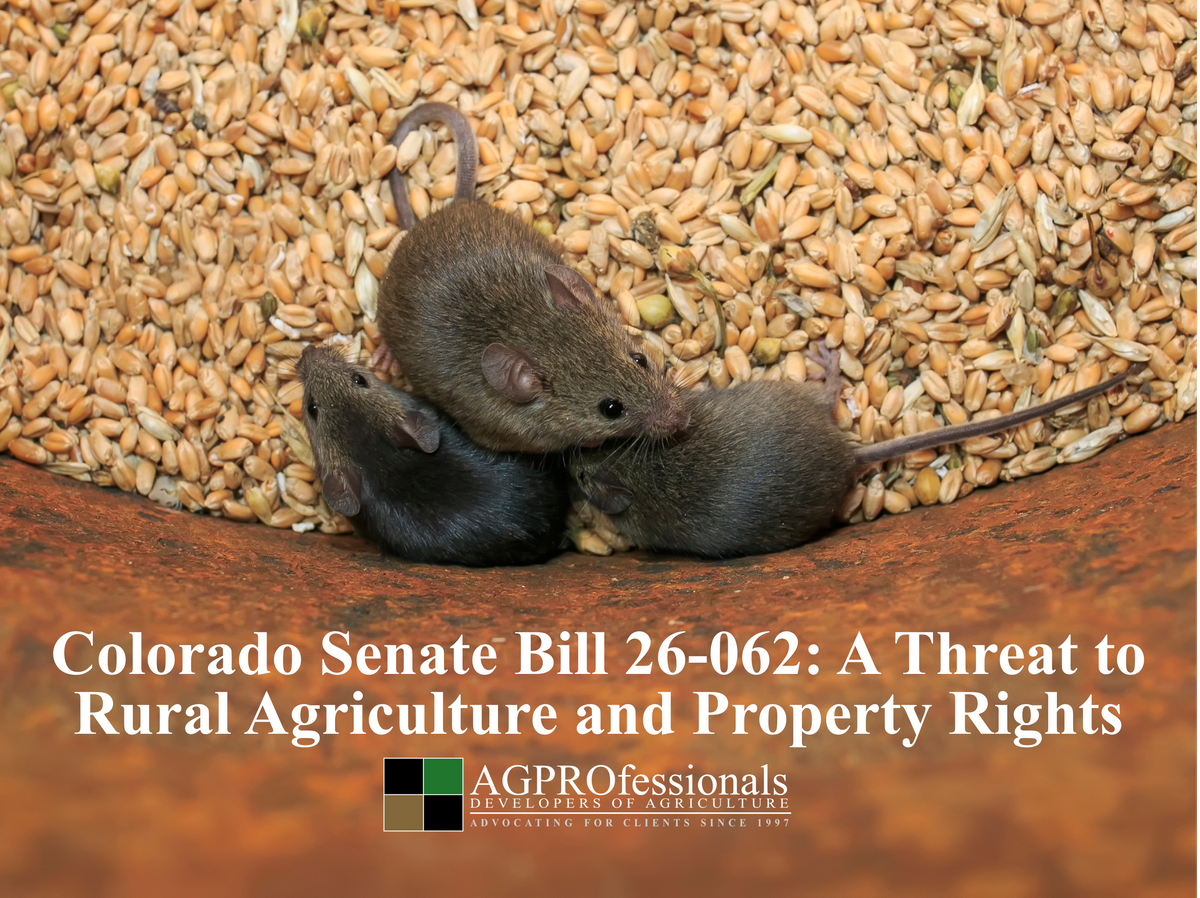
Colorado Senate Bill 26-062: A Threat to Rural Agriculture and Property Rights
Colorado Senate Bill 26-062 introduced in the 2026 legislative session, is being sold by its sponsors as a measure to “protect children, pets, and wildlife” by restricting rodent control products across the state. But a closer look at the bill’s language and practical consequences reveals a one-size-fits-all mandate that would cripple essential pest management tools for farmers, ranchers, and rural property owners.
What the Bill Would Do
SB 26-062 would prohibit the sale, distribution, application, or use of most traditional rodenticides, including first-generation and second-generation anticoagulant rodenticides, non-anticoagulant rodenticides such as bromethalin and zinc phosphide, and rodent glue traps, unless narrowly authorized for restricted and limited use during a public health emergency and under very specific conditions set by the Colorado Department of Agriculture
Under the bill:
- Routine or preventative rodent control, even for agricultural storage buildings, barns, and feed facilities, would generally be banned.
- Any allowable use would be subject to stringent requirements like electronic monitoring, evidence of infestation, extensive documentation, and an active emergency declaration.
- Professional applicators would have to pursue integrated pest management (IPM) strategies first, and only after those fail, might limited chemical use be considered.
At first glance, the bill’s environmental and health arguments may seem well-intentioned. But the consequences across rural Colorado, where rodent pressures are real and omnipresent, could be severe.
Why SB 26-062 Hurts Agriculture and Rural Property Owners
1. Rodent Control Isn’t Optional for Agriculture
Traditional rodenticides, including zinc phosphide, have been essential tools for controlling rodent populations around agricultural facilities. Removing effective tools statewide and replacing them with a complex approval process for limited use ignores the practical realities of farming and ranching. Unlike urban or suburban pest control, rural operations cannot rely solely on exclusion or sanitation. Rodent pressure around feed and livestock is constant, and prevention often requires multiple methods.
The bill’s restrictive approach, which bans general use first and seeks permission later, is misguided. From grain bins and hay storage to livestock feed rooms and equipment sheds, rodents pose a direct threat to agricultural activities by:
- Contaminating feed
- Spreading disease
- Damaging structures
- Reducing the shelf life of stored crops
2. The “Emergency Only” Exemption Doesn’t Match Real-World Needs
Rodent infestations don’t wait for paperwork or emergency declarations. When mice and rats invade feed or barns, waiting for administrative approvals isn’t an option; it risks disease spread, structural damage, and significant economic losses. Under SB 26-062, even licensed pest management professionals may use these rodenticides:
- Indoor only
- Only at a single location
- During a public health emergency only
- Only if IPM is proven ineffective with monitoring logs and documentation
3. Constitutional and Property-Rights Concerns
SB 26-062 exemplifies a growing trend of the legislature enforcing top-down mandates on private property without clear justification or regard for local conditions. The U.S. Constitution shields the right to use and enjoy private property without excessive government interference. Although states do have police powers to regulate for health and safety reasons, those powers must be balanced with property owners' rights, especially when a regulation unfairly burdens rural businesses that already operate on thinner margins than their urban counterparts.
Conflicts For Dairies, Food Processors, And Restaurants
Beyond the obvious agricultural impacts, SB 26-062 creates a direct and serious regulatory conflict for dairies, food processors, and restaurants across Colorado. The federal Grade “A” Pasteurized Milk Ordinance (PMO), which is the national standard governing milk production and processing, explicitly requires effective insect and rodent control as part of maintaining a sanitary dairy operation. Under the PMO standards for Grade “A” raw milk production, “Insect and Rodent Control” is a mandatory compliance item.
These standards are not optional. They form the backbone of interstate milk commerce and food safety. If producers cannot effectively control rodents due to a statewide rodenticide ban, they risk falling out of compliance with federal milk sanitation requirements. This threatens not only individual dairy operations but also Colorado’s standing in interstate milk markets.
The same conflict affects restaurants, grocery stores, food warehouses, and food processors. Colorado’s Retail Food Establishment Rules include a dedicated chapter on “Insect, Rodent and Animal Control,” which requires establishments to actively prevent and control pests.
Colorado Already Has a Tightly Regulated Framework for Rodent Control
Meanwhile, Colorado's existing regulations already strictly control how rodenticides can be used, mandating EPA-registered products, requiring tamper-resistant bait stations, and enforcing careful application protocols. In other words, Colorado already has a well-regulated system that ensures rodenticides are used safely and responsibly. SB 26-062 would not “add safety”; it would remove a key tool that businesses rely on to comply with public health laws.
Dairies, food processors, and restaurants could find themselves in the impossible position of being legally required to eliminate rodent infestations while losing access to the most effective method to do so.
Lawmakers Are Putting Public Health at Risk
Rodents are not just a destructive nuisance; they carry salmonella, listeria, hantavirus, and other pathogens. In dairy environments, contamination risks directly affect milk quality and consumer safety. In restaurants and food storage facilities, rodent presence can result in immediate closure by health departments. By broadly restricting rodenticide use, SB 26-062 risks increasing the very public health dangers that existing federal and state regulations are designed to prevent.
Do the Bill Sponsors Understand Rural Colorado?
The bill sponsors may genuinely be concerned about the environment and public health, but an important question remains: Do they have the agricultural or rural property experience needed to understand how limiting rodent control tools will affect farmers, livestock producers, feedlot operators, grain facility owners, and rural landowners? Furthermore, while misuse of rodenticides should be discouraged and non-chemical methods promoted where feasible, a complete ban with emergency-only exemptions is an extreme policy that harms rural Colorado.
SB 26-062 is sponsored by:
- Senator Lisa Cutter (D-Jefferson County): A longtime communications professional who founded a public relations firm and has a record of focusing on education, healthcare, environment, and community issues, but not on agriculture or rural pest management.
- Senator Cathy Kipp (D-Fort Collins): A former database engineer and school board member focused on education and environmental priorities, with no disclosed background in agriculture or farm operation.
- Representative Elizabeth Velasco (D-House District 57): A business owner and interpreter service CEO with experience in hospitality and community advocacy, and first Latina member from her district, but not a documented history in agricultural pest management.
Alternatives Exist, But Not in SB 26-062’s Current Form
As mentioned previously, Colorado already has regulations on pesticide use and labeling, and integrated pest management is widely promoted in agriculture. The question is whether a law that effectively bans tools farmers depend on, without providing flexible, practical alternatives, can be justified.
Responsible pest control policies should:
- Protect children and pets without disarming rural property owners.
- Promote education and best practices rather than strict bans.
- Offer targeted safeguards for sensitive populations while maintaining pragmatic options for farms and businesses.
- Respect property rights and local decision-making instead of implementing broad statewide mandates.
Final Thoughts
Agriculture is the foundation of rural economies and our national food security. Colorado’s legislators must remember that rodent pressure on a farm or ranch is not a theoretical environmental concern; it is a daily operational reality. Restricting tools without practical alternatives, and doing so based on urban environmental policy templates, risks damaging rural property owners, agricultural businesses, and the broader agricultural economy.
Before Colorado moves forward with SB 26-062, lawmakers should take a step back and ask: have we balanced public health goals with constitutional property rights, and do the bill sponsors truly understand the agricultural and rural impact of what they are proposing?
SB 26-062 is also a troubling example of government overreach into private property and lawful business operations. Colorado is not simply “discouraging misuse” of rodenticides; it is moving toward a framework where producers and food businesses are expected to meet strict sanitation and pest-control mandates, while being stripped of the tools necessary to comply. That is not responsible public health policy. It is regulation that sets citizens up to fail, undermines food safety, and punishes rural property owners for operating essential facilities that keep Colorado fed.
What You Can Do
The most effective thing producers can do is to share concerns about bills impacting agriculture with their representatives. It is important that representatives hear from both individuals and from agricultural associations. If you do not know your representative, you can visit the Colorado General Assembly website to obtain their contact information. A brief description of your concerns and referencing the bill is all that is needed. You are also more than welcome to download this article (see link) and send it to them via mail or email.
Links
Find Your Representative on the Colorado State Assembly Website HERE
Bill Language and other information HERE
Link to contact Senator Lisa Cutter HERE
Link to contact Senator Cathy Kipp HERE
Link to contact Representative Elizabeth Velasco HERE