
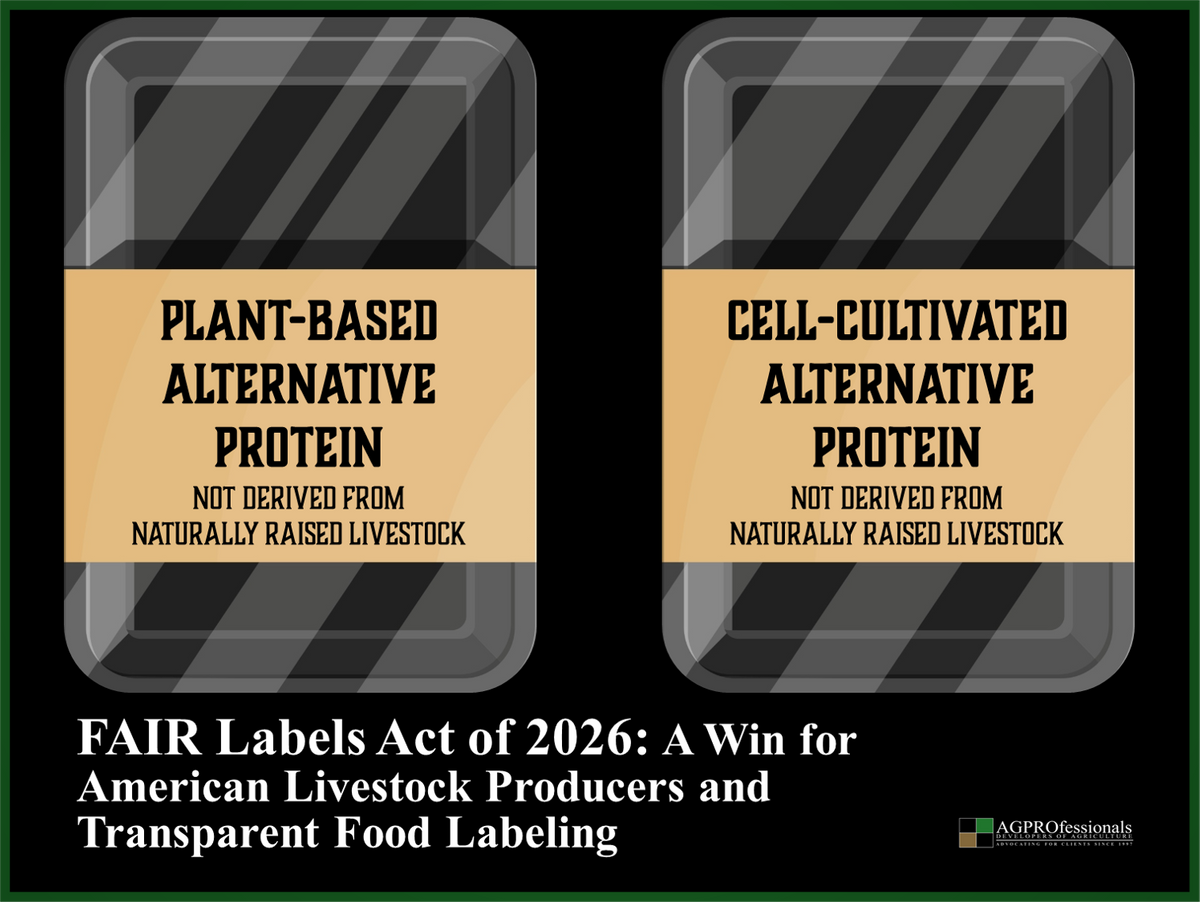
FAIR Labels Act of 2026: A Win for American Livestock Producers and Transparent Food Labeling
The Fair and Accurate Ingredient Representation (FAIR) Labels Act of 2026 represents a significant and timely advancement for American agriculture, particularly for producers in the dairy, beef, pork, poultry, and broader livestock sectors. As alternative protein products, both plant-based and cell-cultivated, continue to enter the marketplace, this legislation establishes long-overdue clarity and fairness in labeling. The Act is a meaningful step toward protecting market integrity, consumer trust, and the value of real animal agriculture.
Ensures Consumers Can Make Informed Purchasing Decisions
At its core, the FAIR Labels Act ensures that consumers can make informed purchasing decisions by requiring accurate, transparent labeling of alternative protein products. Specifically, the legislation mandates that cell-cultivated products be clearly labeled as “cell-cultivated,” while plant-based products must be identified as “plant-based alternative protein.” Additionally, these products must include disclaimers stating they are not derived from naturally raised livestock. This straightforward requirement eliminates ambiguity at the meat case and reinforces a clear distinction between traditionally raised animal proteins and manufactured alternatives.
Cell-Cultivated Foods Will No Longer Be Able to Hijack the Names of Real Meats and Dairy
This distinction is critical for livestock producers. Over the past several years, the use of traditional meat terminology by alternative protein companies has created confusion among consumers. Products marketed using familiar terms like “beef,” “chicken,” or “pork”, without clear qualifiers, have blurred the lines between real animal protein and imitation products. The FAIR Labels Act addresses this issue directly by prohibiting misleading labeling practices and establishing enforceable federal standards.
This clarity benefits every segment of animal agriculture. In the beef industry, producers who invest years into raising high-quality cattle now have stronger protections for the terminology that reflects their product. Pork and poultry producers will similarly benefit from a marketplace where their products no longer compete with mislabeled alternatives. For dairy producers, while the Act focuses more on meat and protein labeling, the broader precedent of enforcing truth in labeling also strengthens ongoing efforts to protect dairy terminology.
Regulatory Framework Established for Cell-Cultivated Foods
Beyond labeling, the FAIR Labels Act also establishes a more robust regulatory framework for cell-cultivated protein products. It formalizes oversight responsibilities between the U.S. Department of Agriculture (USDA) and the Department of Health and Human Services (HHS), ensuring that these products are subject to consistent safety evaluations, inspections, and production standards. This is particularly important as new technologies emerge. By holding alternative protein products to defined regulatory standards, the Act helps ensure a level playing field between traditional livestock production and newer manufacturing processes.
Standardized Identity Definitions
Another key provision of the legislation is the development of standardized “identity definitions” for both plant-based and cell-cultivated proteins. These standards provide clear regulatory boundaries around what qualifies as each type of product, preventing future attempts to stretch or reinterpret labeling definitions that could mislead consumers. This reduces long-term uncertainty and protects the integrity of established product categories for livestock producers.
Supports Rural Economies
The economic implications of the FAIR Labels Act are equally significant. Livestock production is a cornerstone of rural economies across the United States, supporting jobs, land stewardship, and generational family operations. When consumers are misled by unclear labeling, it undermines the market signals that producers rely on. By restoring transparency, the Act helps ensure that purchasing decisions are based on accurate information. This allows real meat, poultry, and dairy products to compete on their true merits of quality, nutrition, and production practices.
Bipartisan Support
Importantly, the FAIR Labels Act has garnered bipartisan support, reflecting a broad recognition that truthful labeling is not a partisan issue; it is a consumer protection issue. Industry organizations such as the National Cattlemen’s Beef Association have strongly endorsed the legislation, emphasizing its role in protecting both producers and consumers from misleading marketing practices. This alignment between policymakers and producers signals a growing commitment to maintaining transparency in the evolving protein marketplace.
Strategic Opportunity for Livestock Producers
The FAIR Labels Act also presents a strategic opportunity. As consumers increasingly seek information about where their food comes from, clear labeling reinforces the story of real agriculture. It allows producers to confidently differentiate their products and communicate the care, expertise, and stewardship that go into raising livestock. In a marketplace crowded with claims and counterclaims, truth becomes a powerful marketing advantage.
In conclusion, the FAIR Labels Act of 2026 delivers meaningful benefits to the entire livestock sector by reinforcing transparency, protecting established agricultural terminology, and ensuring fair competition in the protein marketplace. The legislation affirms the value of their work and strengthens their position in an increasingly complex food system for dairy, beef, pork, poultry, and other livestock producers. By aligning regulatory policy with common-sense labeling practices, the FAIR Act supports both informed consumers and the long-term viability of American animal agriculture.