
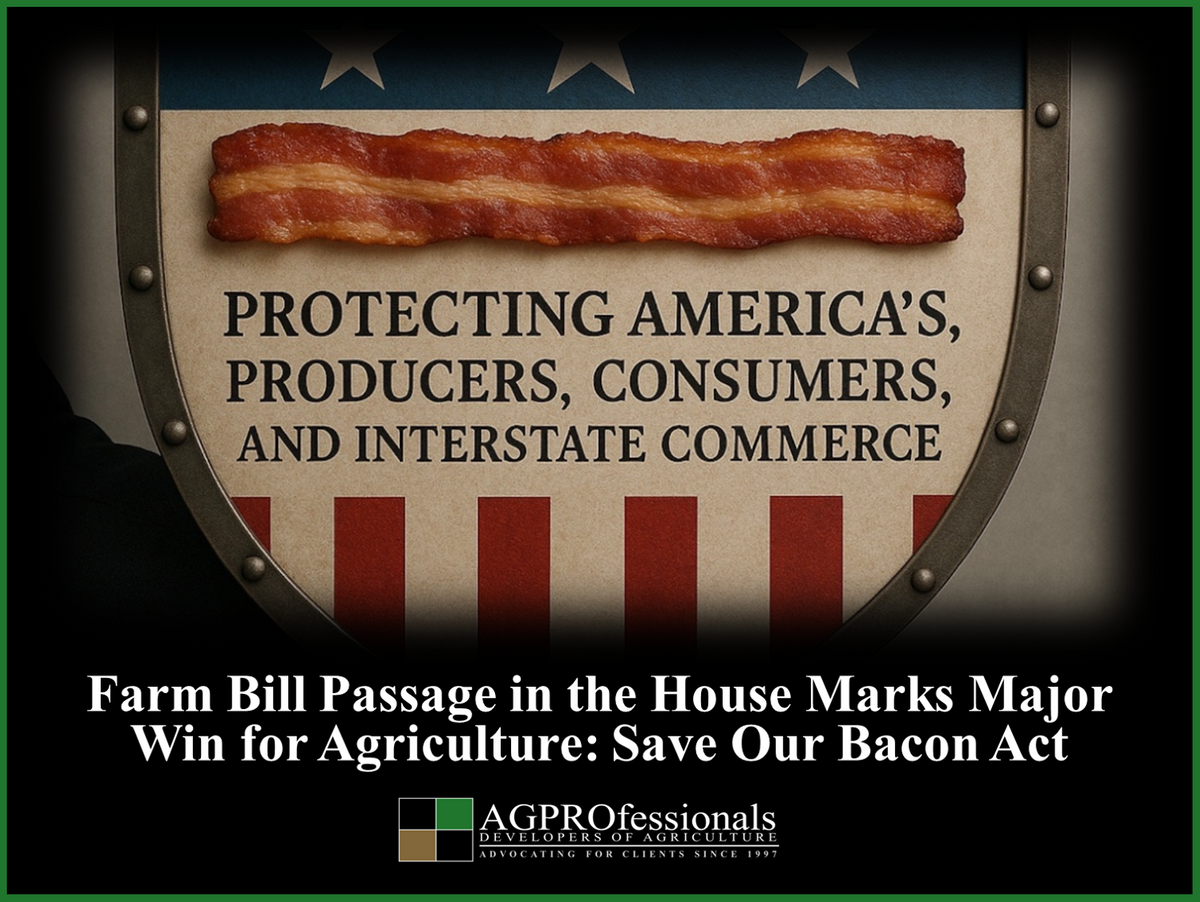
Farm Bill Passage in the House Marks Major Win for Agriculture: Save Our Bacon Act
The recent passage of the 2026 Farm Bill by the U.S. House of Representatives represents a pivotal moment for American agriculture, particularly for livestock producers facing increasing regulatory pressure from state-level mandates. Approved by a bipartisan vote of 224 to 200, the Farm Bill legislation includes a critical provision known as the Save Our Bacon Act, a measure designed to restore certainty in interstate commerce and prevent a patchwork of conflicting state laws governing livestock production.
The Save Our Bacon Act signals more than just policy progress; it is a reaffirmation of the foundational principle that agriculture operates within a national marketplace. Without federal clarity, producers have increasingly been forced to navigate inconsistent regulations driven by states like California and Massachusetts, creating uncertainty, rising costs, and barriers to market access.
What Is the Save Our Bacon Act?
The Save Our Bacon Act, introduced by Representative Ashley Hinson of Iowa, is focused on protecting the free movement of livestock-derived products in interstate commerce. The bill explicitly establishes that producers have a federal right to raise and market livestock across state lines, and it prohibits individual states from imposing production standards on products originating outside their borders.
The legislative text outlines several key purposes, including protecting interstate commerce, encouraging a national market for livestock products, and preventing a fragmented system of state-by-state mandates that could disrupt the food supply.
In practical terms, this means that states cannot require farmers in other states to comply with their specific production methods as a condition of selling products within their borders. This is particularly significant in response to laws like California’s Proposition 12, and Massachusetts Question 3, which impose housing standards on pork, egg, and veal producers nationwide, regardless of where the animals were raised.
The broader Farm Bill language reinforces this same concept. Section 12006, titled “Ensuring the Free Movement of Livestock-Derived Products in Interstate Commerce,” emphasizes that producers should not be subject to a patchwork of state laws and affirms their right to participate in a national marketplace.
Iowa Representative Ashley Hinson and Cosponsors
Representative Ashley Hinson deserves recognition for her leadership on this issue. She not only introduced the Save Our Bacon Act, but also testified before Congress, sharing real-world perspectives from livestock producers who would be directly affected by policies such as Proposition 12.
Her efforts have been instrumental in advancing legislation that protects family farms, supports rural economies, and keeps food affordable for consumers.
We also extend our thanks to the bill’s cosponsors, including Representatives Randy Feenstra, Zachary Nunn, Mariannette Miller-Meeks, Sam Graves, David Rouzer, Gregory Murphy, Mark Messmer, Adrian Smith, Mike Flood, Doug LaMalfa, Mark Alford, Dusty Johnson, Mike Bost, Dan Newhouse, Mark Harris, Brad Finstad, Tony Wied, and John Rose, for standing with agriculture and supporting common-sense policy that protects interstate commerce.
The Prop 12 and Question 3 Legal Battles
The need for federal action has been underscored by a series of ongoing legal battles over California’s Proposition 12 and Massachusetts’ Question 3. These laws seek to regulate how livestock is raised, even when production occurs outside the state. The most notable case, National Pork Producers Council v. Ross, reached the United States Supreme Court, which ultimately upheld Proposition 12. The Court acknowledged that while the law affects interstate commerce, it does not violate the Constitution under current interpretations. Importantly, it emphasized that Congress has the authority to address these issues legislatively.
Subsequent cases have continued to challenge similar laws. In Triumph Foods v. Campbell, the First Circuit Court of Appeals upheld Massachusetts’ Question 3, rejecting multiple constitutional arguments, including claims under the Commerce Clause, Due Process, and federal preemption.
In Triumph Foods v. Bonta, a federal court dismissed challenges to Proposition 12, again finding that the law did not violate federal statutes or constitutional provisions. However, some claims were dismissed without prejudice, leaving room for continued litigation.
Additionally, the U.S. Department of Justice has filed lawsuits related to egg-production provisions tied to these types of laws, further highlighting the ongoing legal uncertainty surrounding state-level mandates.
These cases collectively demonstrate that the judiciary alone cannot resolve the growing conflict between state regulations and national agricultural markets. Congressional action, such as the Save Our Bacon Act, is necessary to provide clarity and consistency.
The Real Impact of Prop 12
Beyond the courtroom, the real-world consequences of Proposition 12 have been significant. California represents a major share of the national pork market, forcing producers to either comply with costly and complex mandates or lose access to a critical customer base. Estimates have shown that compliance costs can reach thousands of dollars per sow, while consumers have already seen price increases, including a reported 41 percent rise in pork loin prices in California following implementation. This is the exact type of economic disruption the Save Our Bacon Act seeks to prevent.
Misleading Narratives and Advocacy Campaigns
As policymakers discuss these matters, it’s clear that not all voices truly reflect the agricultural community’s views. Some new groups have emerged, using names that suggest they represent a broad range of producers, yet they promote ideological positions that most livestock producers do not share. For instance, at AGPROfessionals, we recently examined and wrote about a group called “American Meat Producers,” which supports California Prop 12 and has sought to remove the Save Our Bacon Act from the Farm Bill.
An article in Meating Place reported, “The American Meat Producers Association (AMPA) called it a betrayal of American family farmers. “Section 12006 will reverse hundreds of state agriculture laws across the country and devastate thousands of farmers who’ve already made significant investments in meeting responsible production standards,” AMPA President and CEO Holly Bice said. “The fight is far from over. We oppose this so-called ‘Farm Bill,’ and we’ll be taking this fight to the Senate.”
Although American Meat Producers claims to represent farmers and ranchers, Holly Bice is actually an animal rights activist connected to Lewis and Clark’s animal rights law program, the Humane Society of the United States (now Humane World for Animals), and Farm Sanctuary. All of which promote an ideological agenda opposed to animal agriculture and large modern farms.
These types of efforts by groups like American Meat Producers often rely on strategic messaging, using familiar language and branding to create confusion among lawmakers and the public. In many cases, these campaigns are part of a broader effort rooted in animal rights ideology, which ultimately seeks to eliminate animal agriculture rather than improve it.
It is critical for lawmakers to understand who is truly representing agricultural producers and who is advancing policies that could undermine the long-term viability of American farming and ranching.
Looking Ahead
The inclusion of the Save Our Bacon Act in the Farm Bill is a major step forward, but the process is not yet complete. The legislation now moves to the Senate, where its fate will be decided.
The stakes for agriculture could not be higher. At its core, this issue is about whether a single state can dictate production practices for the entire country or whether the United States will maintain a unified national marketplace that supports farmers, ranchers, and consumers alike.
The passage of the Farm Bill with section 12006 intact represents a strong stand in favor of interstate commerce, agricultural innovation, and producers' continued ability to feed a growing nation.
Links
Texas Ag Law Article with more details about the legal challenges to Mass Q 3 and Prop 12 HERE
Announcement by Representative Hinson on the Save Our Bacon Act HERE
MeatingPlace article about the Farm Bill HERE
MeatingPlace article about the cost analysis done regarding Prop 12 HERE