
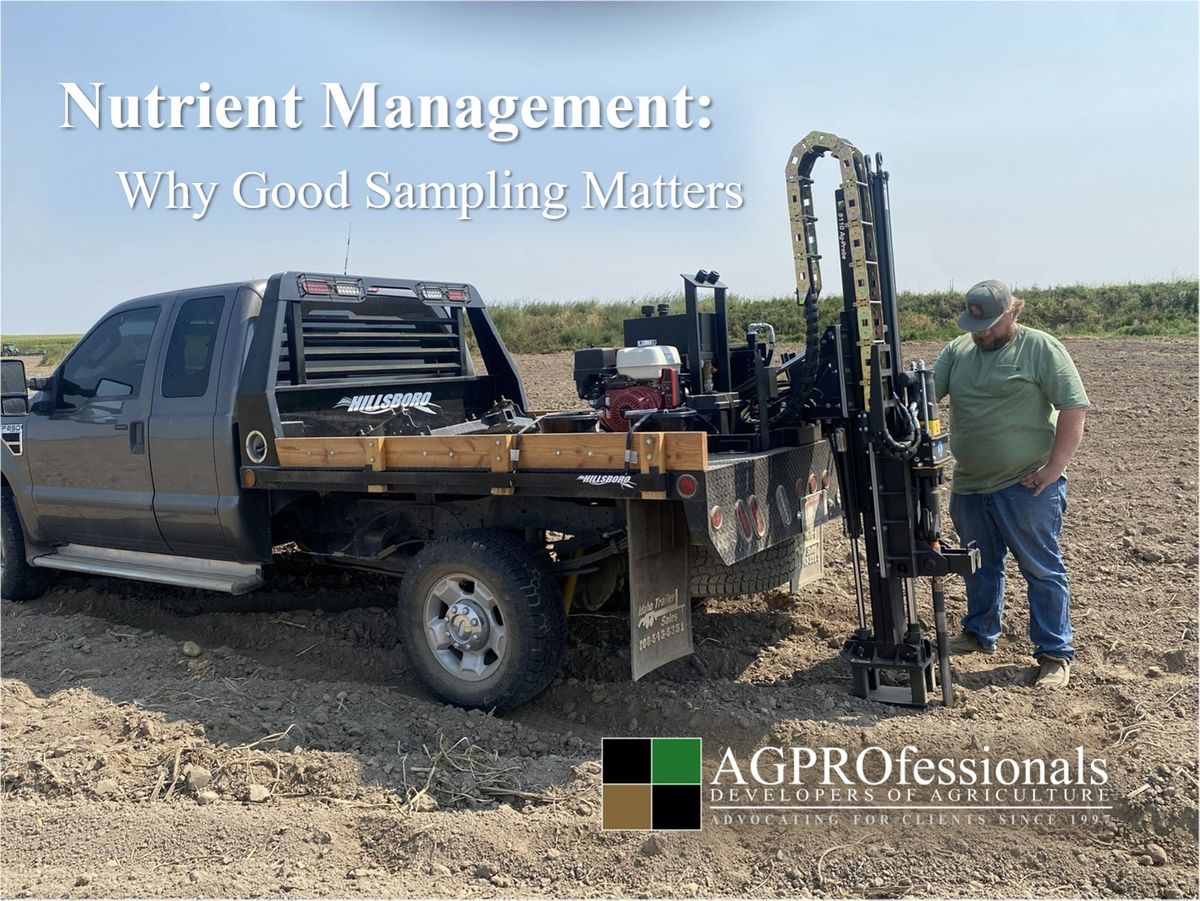
For agricultural operations, the soil beneath a field is more than a growing medium; it’s an important part of the nutrient management equation. Knowing what nutrients are already present in the soil helps producers make informed decisions about manure and fertilizer applications while supporting crop productivity, environmental stewardship, and regulatory compliance.
For Concentrated Animal Feeding Operations (CAFOs), including dairies, feedlots, pork and poultry operations, and egg producers, soil sampling is a key part of developing and maintaining an effective Nutrient Management Plan (NMP).
Start With a Soil Test
The goal isn't simply to apply nutrients. It is to apply the right nutrients, at the right rate, in the right place, and at the right time, so knowing what’s already in the field is the first step. Soil testing provides information about existing levels of nutrients such as nitrogen, phosphorus, and potassium, along with other soil chemical characteristics that can influence crop production and fertility requirements.
This information helps agronomists and producers determine how much additional nutrient a crop may need, and how much may already be available through existing soil nutrients or manure applications.
Sampling Correctly Matters
The usefulness of a soil test depends on obtaining a representative sample. Part of obtaining a representative sample involves how a field is spatially divided before sampling. Fields may be divided into sampling zones based on factors such as soil type, slope, cropping plans, and areas where manure or fertilizer will be applied. Additional methods may also include grid sampling where a soil core is taken every 1, 2.5, or 5 acres. Whole-field or random sampling may also be considered for uniform fields where there are known low levels of chemical, topographical, and management variability.
Once the approach has been selected, multiple soil cores from a representative area are typically combined to create a composite sample for laboratory analysis. Sampling depth can vary based on crop type, nutrient management requirements, and for CAFO’s, regulatory requirements. Depending on the situation, samples may be collected from both the surface layer and deeper soil profile.
Proper sample handling is also required if soil samples are not able to be delivered to the lab immediately. The best practice is to allow soil samples to air dry by spreading the sample across paper or cardboard. This stops microbial activity and slows down chemical reactions that could occur after sampling. Once submitted to the testing lab, samples are then analyzed for nutrients, pH, organic matter, and other soil properties relevant to the nutrient management program.
Turning Soil Test Results Into Better Decisions
The real value of a soil test comes from using the resulting data to make sound agronomic and nutrient management decisions. At a basic level, the results help operators match manure and fertilizer applications to crop nutrient needs.
More importantly, your test results and Nutrient Management Plan enable you to:
- Adjust crop rotations and other best management practices.
- Identify opportunities for cover crops or soil amendments.
- Reduce the potential for excess nutrients to move off-site and into waterways.
- Meet applicable nutrient management and regulatory requirements.
In other words, that soil sample becomes a force multiplier for your agricultural operation.
Sampling Is More Than a Compliance Requirement
For CAFO operators, soil sampling may be required under state-specific nutrient management regulations. In some situations, annual sampling is required to develop planning documentation for the agronomic application of manure and wastewater on land application sites. Soil samples may also be used within NMPs to develop phosphorus indexing to minimize surface-water-risk situations.
However, consistent sampling provides value beyond checking a regulatory box. When results are collected and evaluated over time, they can help reveal trends in soil nutrient levels and provide a better foundation for long-term nutrient management decisions.
Build a Better NMP With Better Information
An NMP is only as useful as the information behind it. Current, representative soil test data gives agronomists and producers a clearer picture of field conditions and helps inform nutrient application decisions. That’s why a consistent soil sampling program should be viewed as an investment in both land productivity and the operation's long-term success.
At AGPROfessionals, our agronomy team works with agricultural operations to integrate soil information into practical nutrient management strategies. By combining field data, agronomic expertise, and an understanding of applicable regulatory requirements, we help producers make informed decisions that benefit their crops, their land, and their operation.