
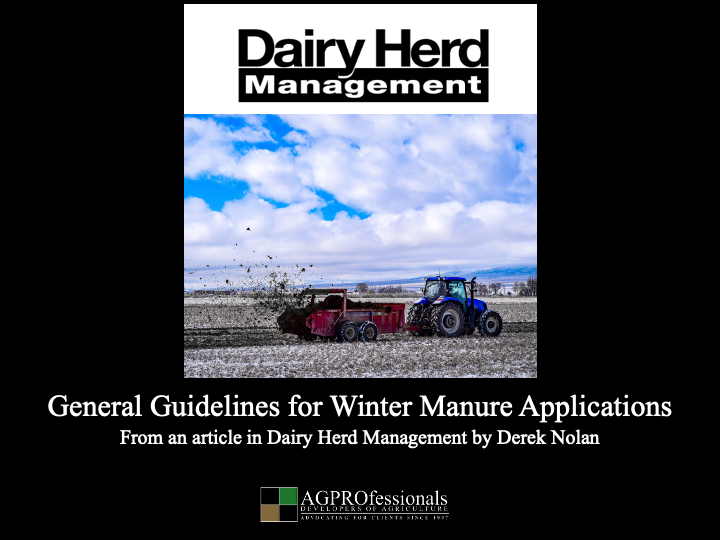
Winter weather arrived early here in the Midwest. Not only did it start early, but we also experienced large fluctuations in temperature and conditions. We saw subzero temperatures and accumulating snow before Thanksgiving, then temperatures in the 60s the week of Christmas. Winter weather can make manure applications very tricky. Each state and local government has regulations for winter manure application. General guidelines can help prevent runoff and nutrient loss, and protect water sources.
Create a Buffer
Most regulations on manure application aim to protect natural water sources. One simple way to help prevent runoff into streams, rivers, and lakes is to create barriers. Maintaining a buffer around surface water, tile inlets, and waterways has been shown to significantly reduce runoff. Research indicates that a 200-foot buffer can decrease nutrient runoff by 80% to 90%. Overall, runoff volume can be reduced by 35% to 90%.
Consider Crop or Residue Cover
Spreading on bare ground can lead to increased runoff. Using crop cover, either with cover crops or crop residue from fall harvest, can significantly reduce runoff. Crop residues or the presence of cover crops as the surface begins to thaw give manure nutrients something to adhere to. Research shows that cover crops can reduce runoff by 40% to 100%, depending on field, crop, and environmental conditions. Fields with less than 25% crop residue tend to have a higher risk of runoff. Low-yielding soybeans and fields used for corn silage often have less than 25% crop cover during winter months. Spreading on fields with cover crops, hay, or pastures would allow for more nutrient absorption.
Make Good Land Choices
Two major factors of land can significantly influence runoff and nutrient loss. The first is the slope of the ground. Avoid applying manure where the ground slopes exceed 15%. Slopes of less than 5% are ideal. The second consideration should be soil type and water-holding capacity. Soil with higher water-holding capacity will result in less runoff. Fine sandy, silty clay, and silt loam soils tend to have the best water retention.
Check the Forecast
If spreading on snow-covered or frozen ground is necessary, be aware of how weather impacts nutrient absorption. Avoid spreading manure before snowmelt or rainfall. Adding moisture to frozen ground will increase nutrient loss. The rate of snowmelt should also be considered. Slower snowmelts allow for increased soil absorption of manure nutrients. Therefore, checking future temperature and weather conditions is important to prevent runoff.
Winter manure spreading is often not recommended because it can lead to higher nutrient losses and harm water quality. Some states have even banned winter spreading. However, if storage capacity is limited and manure spreading is necessary, the guidelines above can help reduce nutrient loss.