
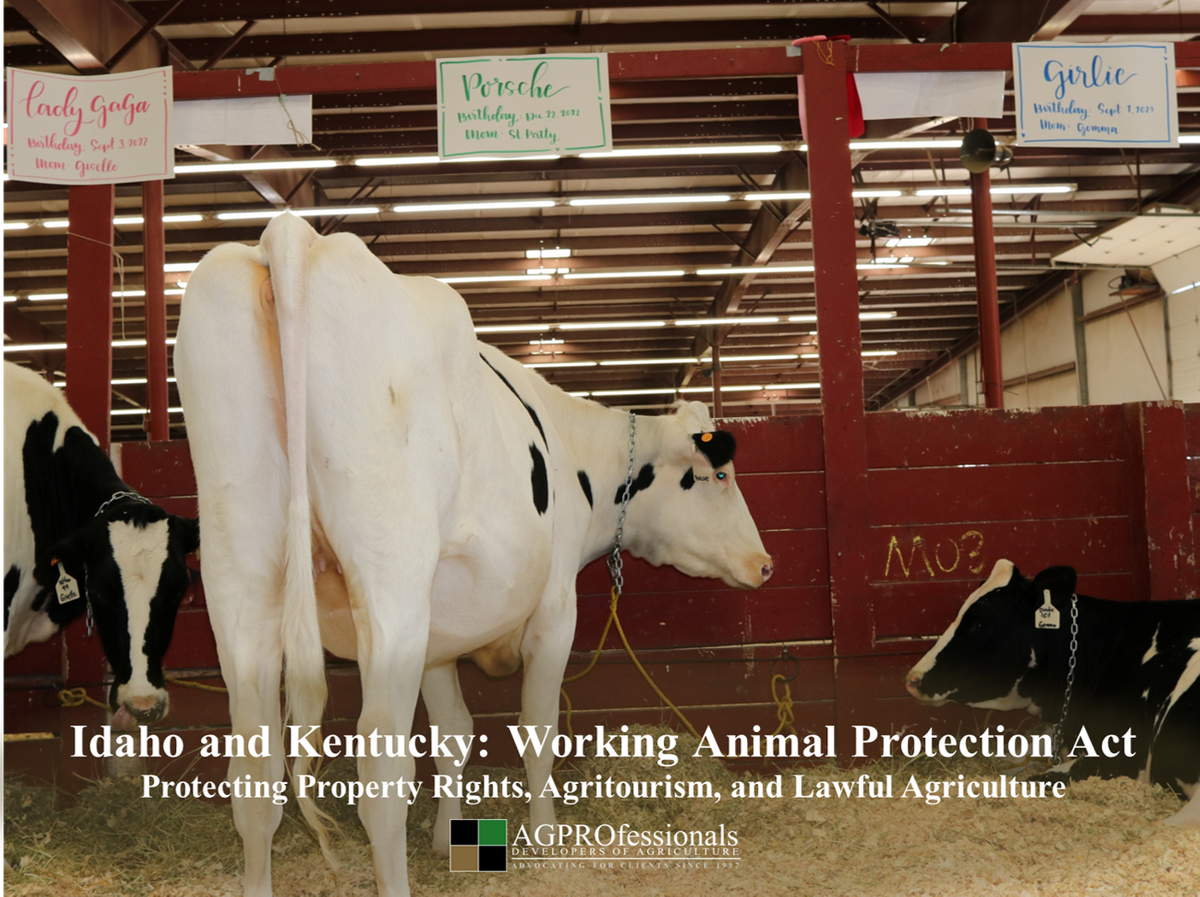
Protecting Property Rights, Agritourism, and Lawful Agriculture
Across the United States, agricultural producers and rural businesses face a growing threat rooted not in genuine animal welfare concerns but in ideology. In recent years, animal rights activist groups have pressured city councils, county commissions, and unelected agencies to increasingly restrict or ban lawful businesses that use animals. The well-funded animal rights organizations behind these efforts have a long-term goal: the complete removal of animals from human care.
These activist campaigns often rely on emotional rhetoric rather than evidence. Local bans are introduced and passed without proof of wrongdoing, ignoring licensing requirements, professional expertise, and regulatory oversight already regulating agricultural and working animal businesses at the state level. As a result, lawful businesses, which operate with high standards, have deep cultural roots, and provide significant economic impact, are targeted and sometimes shut down under political pressure.
The Working Animal Protection Act (WAPA), led by our friends at The Cavalry Group, was created as a direct response to this rise in activist-driven local bans. WAPA offers a modern, practical, and constitutionally sound solution. It reaffirms a core principle of American governance: if an activity is lawful under state law and conducted responsibly, local authorities should not be allowed to ban or effectively eliminate it simply because activist groups oppose it.
In short, WAPA protects property rights, agritourism, agricultural livelihoods, and the longstanding American tradition of working animals, ensuring policy decisions are based on law, science, and established standards rather than ideological pressure.
Why WAPA Matters for Agritourism and Agricultural Producers
Agritourism serves as a vital link between rural America and the public. It connects consumers to farms, ranches, livestock, and rural heritage, fostering understanding and trust. Agritourism also supports:
- Family farms and ranches diversifying income
- Youth and agricultural education
- Rural tourism economies
- The preservation of animal-based traditions
Many agritourism activities depend on animals, such as farm demonstrations and tours, horseback riding, carriage rides, rodeos, livestock shows, ranch demonstrations, and hands-on educational programs. Since agritourism connects agriculture with urban America, provides education, and clears up misconceptions, these activities have become prime targets for activist groups. WAPA defends agritourism and lawful businesses that use animals by preventing local governments from implementing laws or regulations that will effectively shut them down.
The Real Threat: Ideology Disguised as “Welfare”
AGPROfessionals supports the Working Animal Protection Act legislation because it directly addresses a growing reality: animal rights campaigns are not aimed at improving welfare; they seek to eliminate animal agriculture and animal-based work entirely. That ideology ignores the science of animal husbandry, the reality of animal care standards and oversight, the economic role of agriculture, and the cultural heritage of working animals in rural communities. WAPA is a necessary shield against that ideological agenda, especially when it is pushed through local ordinances designed to bypass state-level agricultural expertise and oversight.
Spotlight: Two WAPA Bills Now in Progress
Idaho: Senate Bill 1241 (2026)
Idaho’s proposed Working Animal Protection Act language is clear and would add a new section to Idaho law titled “Protection of Working Animals.” It states:
“The right to utilize working animals for the mutual benefit and welfare of working animals and those they serve shall be guaranteed.”
Idaho’s bill defines working animals broadly as animals used to perform a specific duty or function in commerce or service. This broad definition matters because activists frequently attempt to isolate and target one type of animal use at a time.
This includes but is not limited to:
- Farming
- Ranching
- Hunting
- Agritourism
- Transportation
- Education
- Entertainment (including horse riding and carriage riding)
- Service
Idaho SB 1241 forbids any county, municipality, state agency, or political subdivision from passing or enforcing rules that are either more restrictive than state law or that end or effectively prevent working animal enterprises, especially if they cause undue financial hardship. The term “undue financial hardship” is crucial because it often relates to indirect bans via permit restrictions, insurance mandates, or fee burdens that hinder business operation. Additionally, Idaho SB 1241 explicitly exempts cockfighting and dogfighting, clarifying that the bill does not aim to protect illegal animal fighting activities, countering any false claims.
Kentucky: Senate Bill 45 (2026)
Kentucky SB 45 incorporates the core WAPA protection: Local governments cannot adopt or enforce any ordinance, resolution, rule, or regulation that restricts a person from engaging in agritourism or imposes an undue burden making the activity unreasonable or impractical, provided the activity complies with public health and safety standards and existing planning or zoning requirements.
Kentucky SB 45 defines “working animal” as: “the use of any animal for the purpose of performing a specific duty or function in commerce or service, including but not limited to animals in entertainment, transportation, education, exhibition, hunting, or agritourism.” SB 45 updates the definitions in the state’s agritourism statutes and adds a new section that limits local government interference. It includes a list of qualifying agritourism activities, explicitly naming:
- Livestock or poultry shows
- Petting farms
- Horseback riding
- Horse-drawn carriage rides
- Rodeos
- Competitions
- Field trials
- Horseracing
- Other natural resource-based activities
Then it adds a key phrase:
“...or any activity that has historically involved the utilization of working animals.” This is a strategic and powerful addition, because it protects the traditional and historic relationship between agriculture and working animals, even if activists attempt to redefine those traditions as “unacceptable.”
Like Idaho, Kentucky SB 45 makes clear that agritourism does not include dog fighting or animal fighting.
Supporting WAPA in Idaho, Kentucky, and Beyond
As The Cavalry Group highlights, WAPA has already been enacted in Oklahoma and Arkansas (2021), with an expanded version passing in Texas (2023). This increasing national trend underscores a fundamental truth: Rural America is tired of being governed by urban ideology. The Working Animal Protection Act seeks to safeguard legitimate livelihoods from political interference. It mandates that decisions on animal husbandry, agriculture, and the use of working animals be grounded in science, industry standards, professional oversight, and consistency across states, rather than influenced by activists' emotional campaigns. Essentially, the Working Animal Protection Act embodies a core American principle: If a business is lawful, regulated, and responsibly managed, it should not be threatened by local politics or activist pressure.
Agriculture has no reason to apologize for working with animals. Ranching does not require approval from ideological groups to continue longstanding traditions that have fed, clothed, and supported communities for generations. Working animals are not an issue to be eradicated; they are a vital part of rural America's foundation. WAPA ensures this foundation remains intact, preventing it from being dismantled incrementally through city ordinances.
Links
National Beef Wire Article HERE
Western Ag Reporter Article HERE
Article by The Cavalry Group HERE
Legiscan link to track the Kentucky bill HERE
Legiscan link to track the Idaho bill HERE