
Rutinel explains why he believes elected officials can have significant influence over animal-agriculture policy and describes a shift toward institutional action.
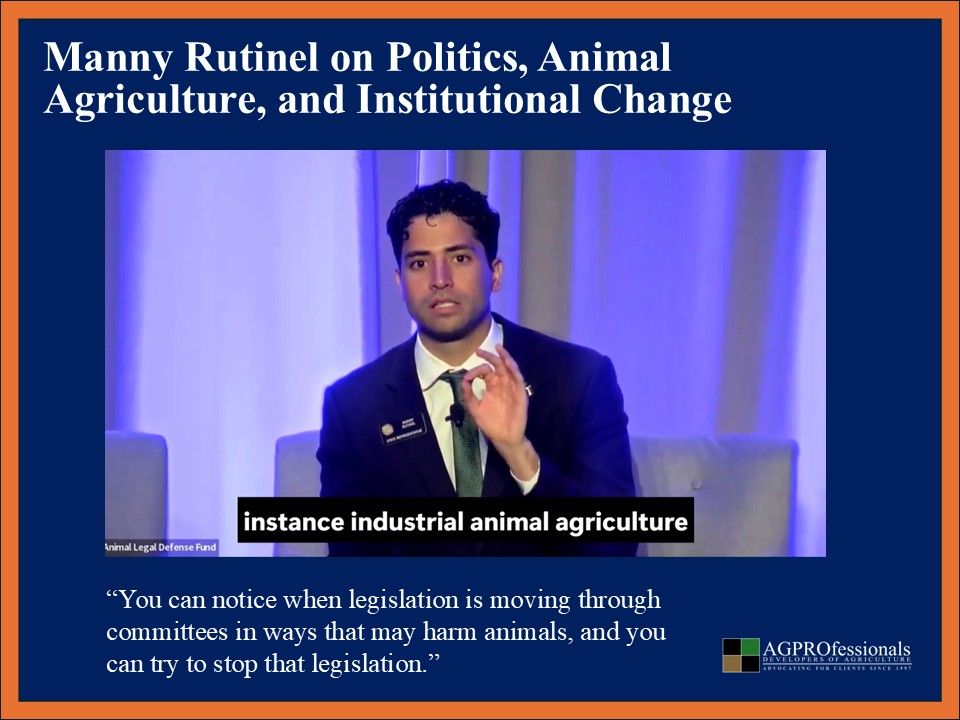
Manny Rutinel on Politics, Animal Agriculture, and Institutional Change
AGPROfessionals News Desk
Rutinel explains why he believes elected officials can have significant influence over animal-agriculture policy and describes a shift toward institutional action.
“You can notice when legislation is moving through committees in ways that may harm animals, and you can try to stop that legislation.”
Transcription:
a 3L at Vermont Law and Graduate School, and I just want to thank you all so much. For being here today, I have two questions. One is directed at Manny. I think it's so important to have animal advocates in local, state and federal legislatures. And I'm just kind of curious about like you're an elected position, so how was campaigning? And I'm really interested in that kind of journey that you went on because I think it's really tough and kind of scary to even think about like running for an elected position. And then?
I want to kind of ask all of you, given what Cheryl said about how she was asking tough questions of animal advocates and kind of where do you all see the movement going? You know, we know where it's been, but where do you see the future of of animal law in the movement things?Yeah. Thanks for the question.
Campaigning is it's the worst job ever. Easily. I mean, I've never been like an Alaska Fisher or whatever. But I think it may be the worst job ever. You're like. Constantly getting harassed. You are constantly getting like publicized in ways that don't suit you or like the journalists will misquote you or you constantly have to asking. Constantly have to ask friends and family for money. You don't know if you're going to win.
It's a horrible job.
That being said, I think it's extremely impactful or has the potential to be extremely impactful for this cause. And the reason for that is because of what I was mentioning earlier that Valeria brought up as well, which is this counterfactual impact question. There are a lot of topics and issues that are really salient politically. And we all know them. We see them in political advertising every single day, like 100 times a day. And then there are issues that are potentially really impactful. Like for instance industrial animal agriculture that gets 0. Time in any political ad, in any political world. And it's not that people don't care about it. It's that it just isn't. It's just not politically salient for a million different reasons. What that means is that if there are elected officials with your values in those positions. You have a huge potential for counterfactual impact. You can bring those ideas to the table. You can notice when legislation is moving through committees in ways that may harm animals, and you can try to stop that legislation. You can try to propose legislation that is positive not just for animals, but for workers, for environmental justice communities, for public health, etcetera, all the things that. So many of us have mentioned are intersected with all these animal issues.
And so there's a huge potential for counterfactual impact, but I will admit that it is the worst job ever.
I think I see the movement moving more towards institutional action as opposed to individual changes. I think I sort of came into this movement in a world in which it was still really popular to do vegan flyering. And I'm not sure if that still happens. It probably does still happen, but I see a lot more of the movements thinking and resources going to institutional action. And I think that's because there has been a lot of. Great pilot programs.
That have demonstrated the immense power of that. So just to give you an example, I'll bring up Prop 12. Prop 12 passed in 2016. When it passed California, only 6% of eggs in California were from cage free hens. That means about 6% of consumers were choosing cage free hens, but when they were presented with it on the ballot, 63% of them said that they wanted all California eggs to be cage free. So
there's this difference between the consumer mindset. And the citizen mindset. Or the corporate executive mindset. And so if we can tackle those leverage points and take advantage of them for the benefit of animals, I think we should because I think the benefit is 10100 a thousand fold of impact compared to the sort of individualized action that I think we've been known for, for a long time.