Manny Rutinel Says He's Changed: 
His Campaign Finance Report Tells a Different Story

Manny Rutinel Says He's Changed: His Campaign Finance Report Tells a Different Story

Manny Rutinel Says He's Changed:

His Campaign Finance Report Tells a Different Story

People can change their minds with facts, and politicians claim they do. However, when a candidate who spent almost two decades opposing animal agriculture on ideological, agenda-driven, emotional, and unscientific grounds then switched to wearing a cowboy hat and saying his views are now “nuanced” while running for office in Colorado's largest livestock district, it sure raises questions. Voters deserve more than brief campaign promises after two-thirds of a man’s life is spent attacking them; they want answers.

This Wasn't a Youthful Phase

Rutinel is trying to convince people that his radical activism belongs in the past. The public record tells a different story. AGPROfessionals has a timeline of Rutinel’s radical activism posted on our website. We encourage readers to review it because the facts speak for themselves

Follow the Money

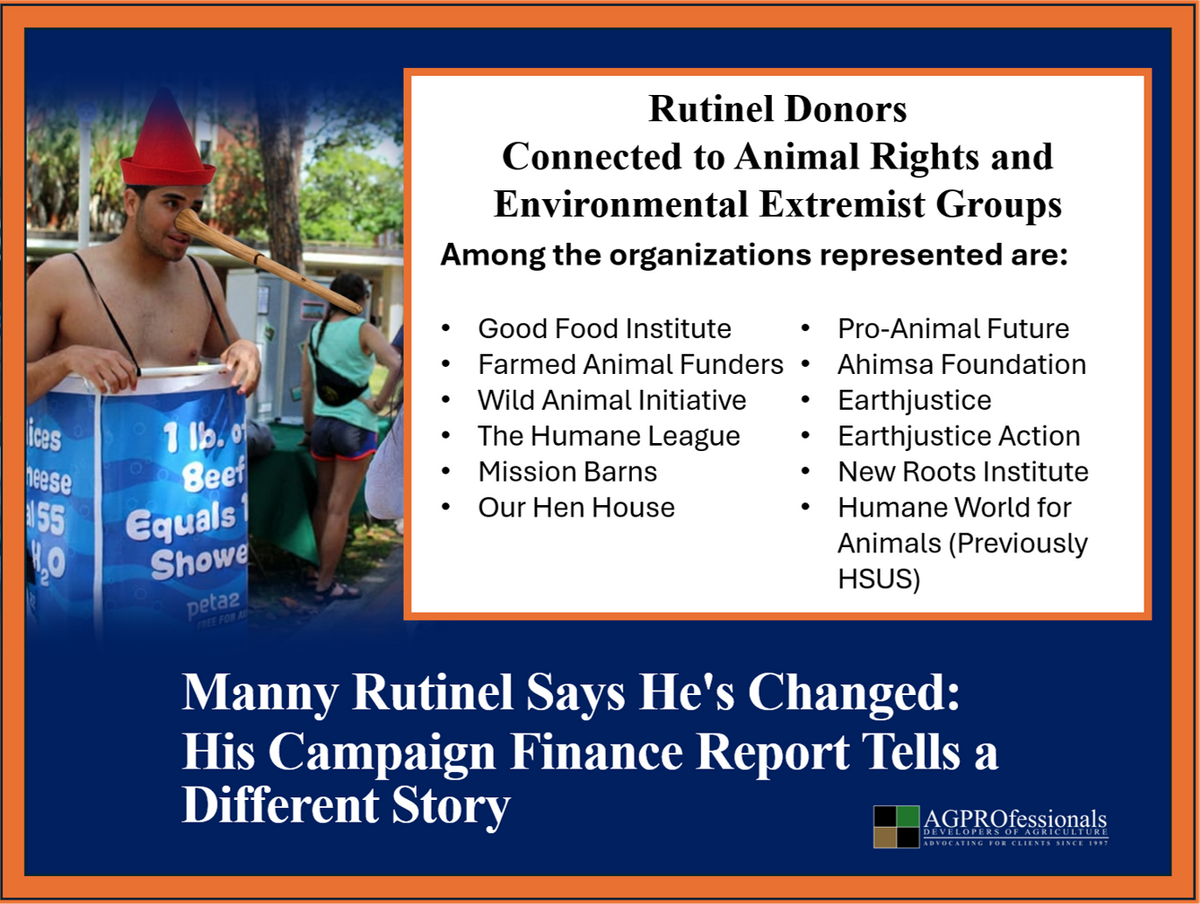
Campaign contributions don't always prove how someone will vote; however, they often reveal which communities believe a candidate shares their priorities. A review of Manny Rutinel's campaign finance report (downloaded July 24th) shows contributions from individuals employed by organizations involved in animal-rights activism, plant-based food systems, cultivated meat, environmental litigation, and other efforts focused on transforming conventional animal agriculture. These are individual contributors' reported employers, not donations or endorsements from the organizations themselves. They are people who are nationally recognized leaders in the animal rights ideological movement. Rutinel's donor base includes individuals affiliated with organizations whose stated missions include ending or fundamentally replacing conventional animal agriculture through litigation, public policy, animal-rights activism, plant-based alternatives, and cultivated meat. For many Colorado producers, that is not simply another political coalition. It is a coalition that has often challenged the future of conventional livestock agriculture itself.

Among the organizations represented are:

  • Good Food Institute
  • Farmed Animal Funders
  • Wild Animal Initiative
  • Humane World for Animals (Previously HSUS)
  • The Humane League
  • Mission Barns
  • Pro-Animal Future
  • Ahimsa Foundation
  • Earthjustice
  • Earthjustice Action
  • New Roots Institute
  • Our Hen House

These contributions come from individual donors, not from the organizations themselves. But taken together, they represent a notable concentration of support from people whose careers have

We have also posted the downloadable report showing campaign contributions and invite readers to review them.
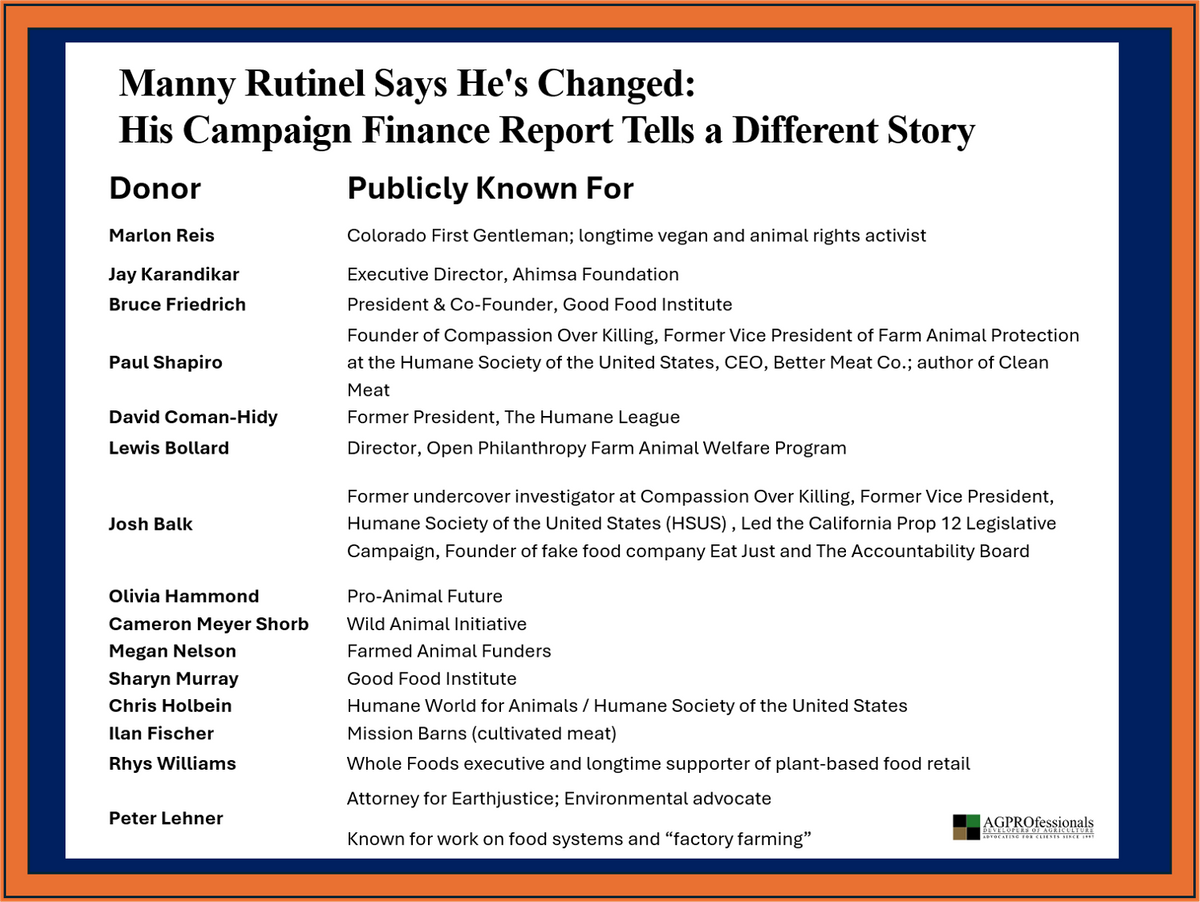
Rutinel Congressional Campaign and the Indivicual Donors with Direct Connections to Radical Animal Rights and Environmental Activist Groups

Rutinel Campaign Individual Donors and their Connections to Animal Rights and Environmental Extremism

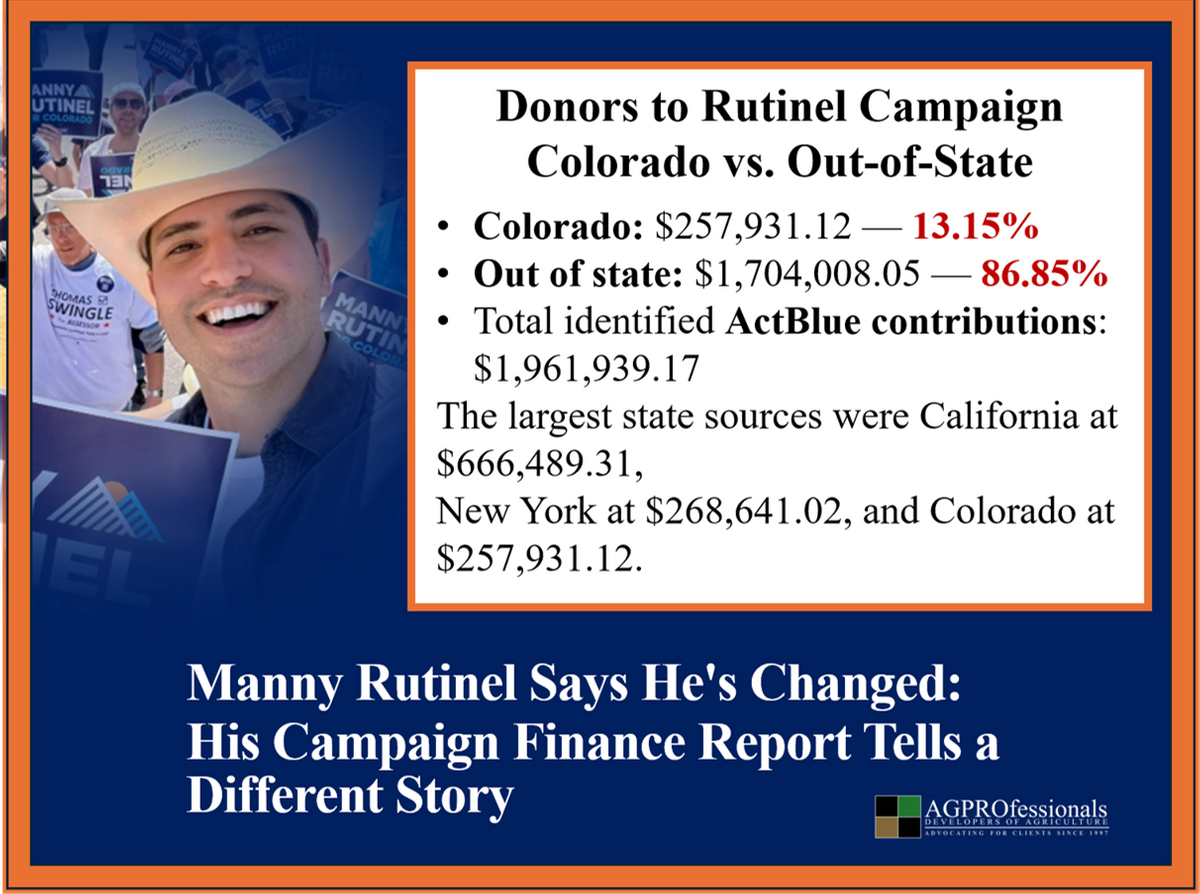
87% of Rutinel’s Campaign Donations Are Out of State and ActBlue Has a Big Influence

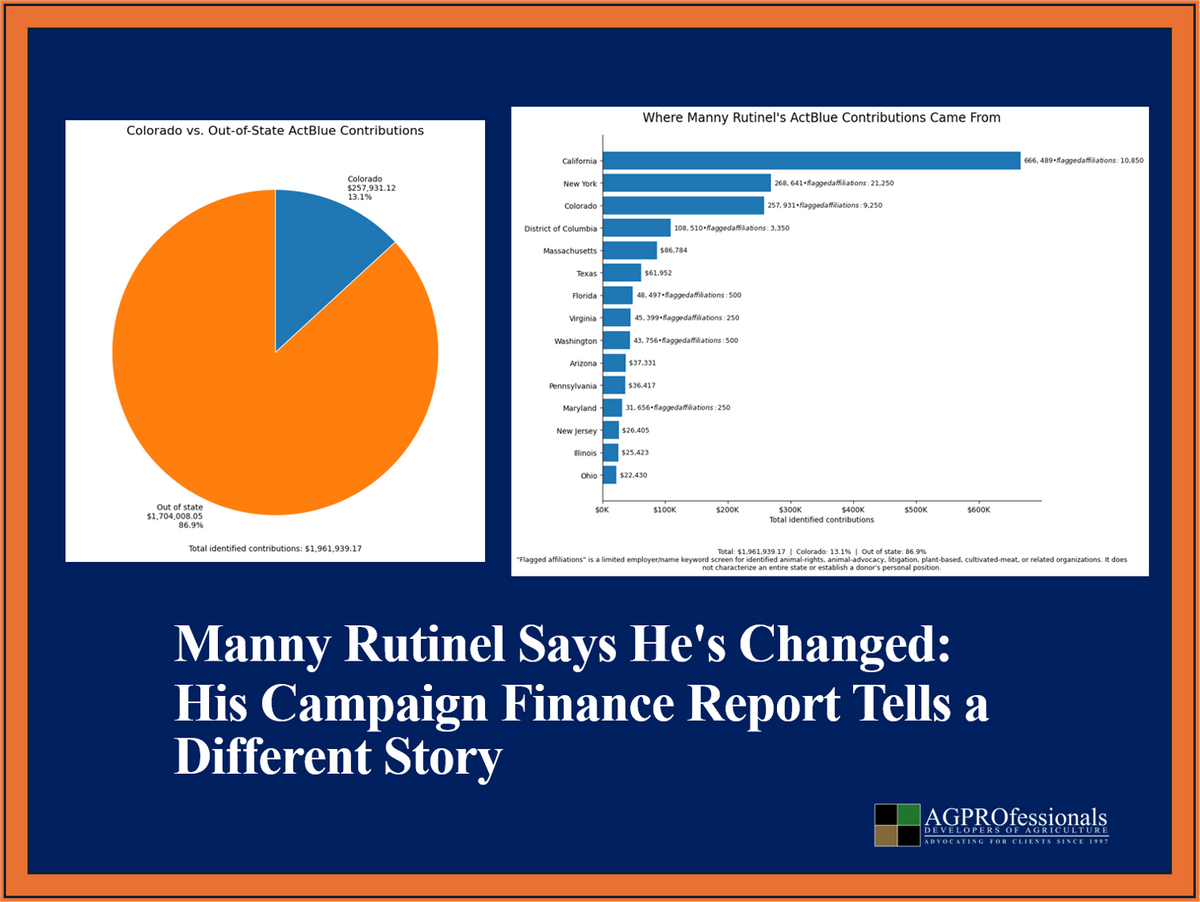
Federal law allows congressional candidates to accept contributions from donors anywhere in the country, and Manny Rutinel's campaign made full use of that opportunity. The campaign received nearly $2 million in identified ActBlue contributions, but only about 13% came from Colorado donors. Nearly 87% originated outside the state, led by California ($666,489) and New York ($268,641)—both surpassing Colorado's $257,931. In other words, while Rutinel is asking Colorado voters to send him to Congress, the bulk of his ActBlue fundraising came from people who won't be casting a ballot in his district.

87% of Rutinel’s Campaign Donations Are Out of State and ActBlue Has a Big Influence

ActBlue has become the Democratic Party's fundraising powerhouse, processing billions of dollars in online political contributions. It has also found itself under congressional scrutiny over allegations that its fraud-prevention systems were not strong enough to prevent suspicious, fraudulent, or potentially foreign contributions and whether donor identities were adequately verified. ActBlue denies those allegations, maintains that it employs robust anti-fraud safeguards, and argues the investigations are politically motivated. As of this writing, the investigations remain ongoing, and no court has found that ActBlue engaged in criminal conduct.

A closer look at those out-of-state contributions also reveals financial support from individuals affiliated with organizations that have long challenged conventional animal agriculture through litigation, animal-rights advocacy, and promotion of plant-based or cultivated meat alternatives. New York led this group with $21,250 in identified affiliated contributions, including $15,950 connected to animal-rights organizations and $5,300 associated with Earthjustice legal advocacy. California followed with $10,850, while Colorado accounted for $9,250. That doesn't mean every donor from those states shares those views, nor does it imply these organizations donated directly to the campaign. It does, however, illustrate that a measurable portion of Rutinel’s financial support for his campaign came from individuals connected to organizations whose policy priorities have often conflicted with those of livestock producers and the broader animal agriculture industry.

Animal Rights Has Nothing to Do with Animal Welfare

The distinction between animal rights and animal welfare matters. For ranchers, veterinarians, and livestock producers, “animal welfare” means raising and caring for animals responsibly while recognizing agriculture, veterinary medicine, ranching, and responsible animal ownership as legitimate and essential. Animal rights is a completely different philosophy.

Many animal-rights organizations argue that animals should not be owned or used by humans at all and have invested hundreds of millions of dollars toward ending practices such as conventional animal agriculture. They view animals in human care as exploitation and abuse. While organizations differ in their priorities and strategies, the ideological agenda of animal rights groups helps explain why Colorado's agricultural community pays close attention when candidates receive significant support from individuals in the animal rights movement. That's why Rutinel's donor network deserves scrutiny, not because campaign contributions determine policy, but because they help reveal which communities see a candidate as aligned with their long-term goals.

That's why the donor list stands out. To recap, Rutinel's donor base includes individuals affiliated with organizations whose stated missions are to end or fundamentally replace conventional animal agriculture through litigation, public policy, animal-rights activism, plant-based alternatives, and cultivated meat. When a congressional campaign draws 94% of its support from out of state and from many of the country's best-known leaders in the animal-rights and alternative-protein movements, Colorado's ranchers, farmers, veterinarians, and livestock producers are justified in asking whether that support reflects priorities that extend beyond campaign rhetoric.

That distinction matters.

Colorado’s Most Famous Animal Rights Ideologue Donates to Rutinel Campaign

Federal campaign finance records show Governor Polis’ partner, Marlon Reis contributed $7,000 to Manny Rutinel's campaign, making him one of the campaign's largest identified individual supporters. As Colorado agricultural producers know from his history and activities, Reis is not simply another Democratic donor.

He is one of the state's most visible public advocates for the animal rights ideological agenda. It's reasonable to ask why one of Colorado's highest-profile vegan and animal rights activists, and why so many individuals connected to organizations working to destroy animal agriculture, believe Manny Rutinel is their candidate.

Colorado Agriculture Deserves Answers

Colorado producers don't owe any candidate blind trust. They deserve clear answers. There is no getting around the public record: outspoken animal-rights activism continued into Manny Rutinel’s time as a legislator, followed by a rapid political pivot as he began seeking higher office in a district where agriculture is a cornerstone of the economy. Colorado's farmers and ranchers aren't unreasonable for noticing that timeline. Nor are they unreasonable for noting that, even as Rutinel says he has left those views behind, his campaign continues to attract support from people whose professional work is dedicated to a radical ideological agenda to change, replace, and end conventional animal agriculture.

The decision about who occupies the 8th Congressional Seat representing Colorado’s agricultural economy is not just about what Manny Rutinel says today, but about whether the values that attracted this donor coalition have truly changed, or whether only the campaign message has.

We say the biggest “tell” is to follow the money, and the money leads right back to the radical animal rights ideological agenda.

Know someone affected by this? Share it 👇