
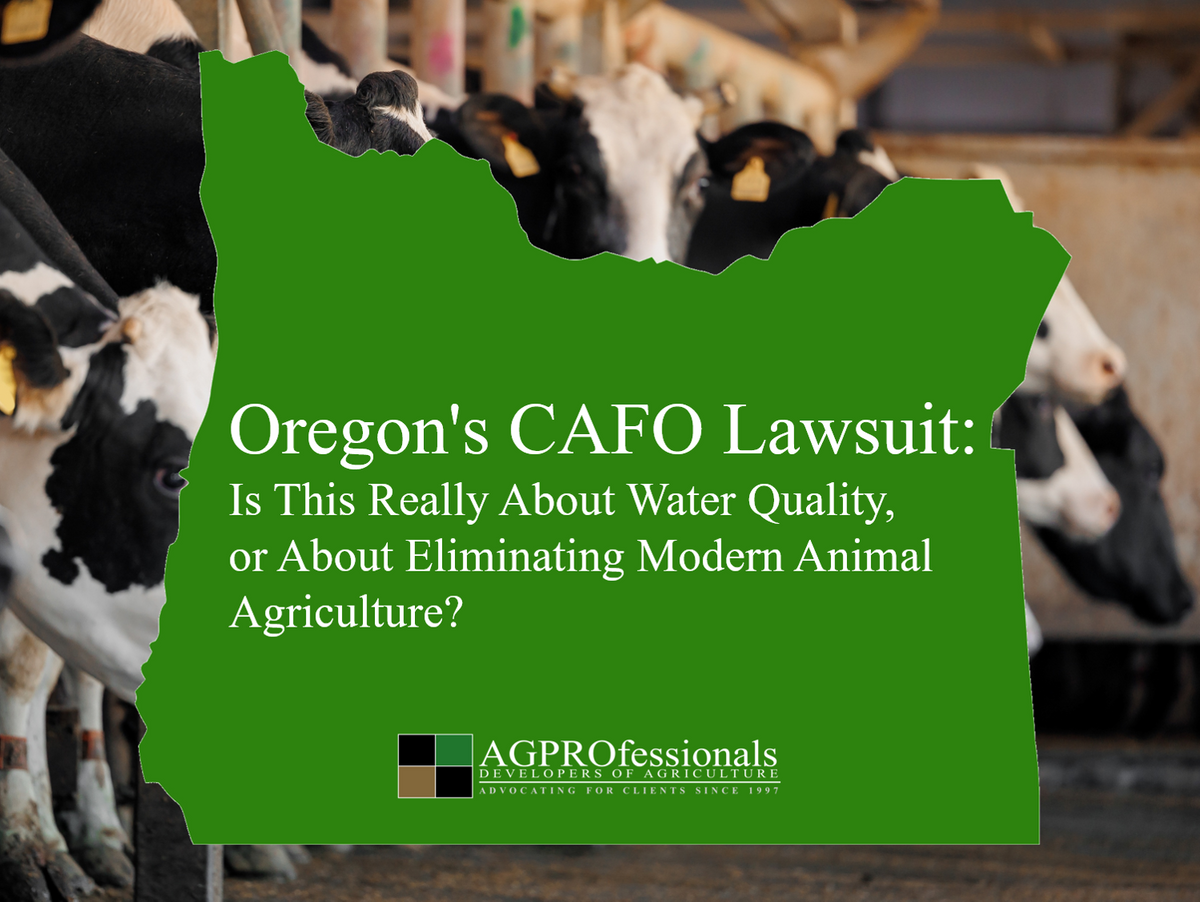
Oregon has maintained one of the nation's most comprehensive regulatory systems governing confined animal feeding operations (CAFOs) for decades. The state's permitting program requires extensive engineering review, nutrient management planning, land use approval, public participation, inspections, monitoring, and ongoing compliance before livestock operations can begin or expand.
Yet despite this extensive regulatory framework, several national activist organizations have filed a lawsuit challenging Oregon's newly adopted 2026 CAFO General Permit. On its face, the litigation argues that the permit should impose additional monitoring and environmental requirements. However, a closer examination of both the lawsuit and the organizations bringing it raises an important question:
Is this lawsuit truly about improving Oregon's regulatory program, or is it another step in a long-term campaign to restrict and ultimately eliminate modern animal agriculture?
The answer matters not only to Oregon livestock producers, but to farmers and ranchers across the United States.
Oregon Already Regulates CAFOs Extensively
Contrary to the public narrative advanced by the plaintiffs, Oregon does not operate under a weak or nonexistent CAFO regulatory system. The Oregon Department of Agriculture (ODA) and the Oregon Department of Environmental Quality (DEQ) jointly administer a comprehensive National Pollutant Discharge Elimination System (NPDES) permitting program under both state and federal law.
The 2026 General Permit was issued only after public review and consideration of comments, and its stated purpose is to prevent pollution of Oregon's waters from CAFO activities. Before receiving approval, operators must submit an extensive application package that includes:
- A Land Use Compatibility Statement approved by local government
- A comprehensive Nutrient Management Plan
- A Water Supply Plan
- Engineering and construction documents
- Application fees
- Preliminary consultations for certain facilities
- Public notice and public comment opportunities
Operations cannot begin until state agencies approve construction, inspect the completed facility, and authorize animal occupancy. The permit itself spans more than thirty pages of detailed operating requirements. These are hardly the hallmarks of an unregulated industry:
- Manure storage
- Wastewater management
- Nutrient application
- Monitoring
- Inspections
- Reporting
- Recordkeeping
- Setbacks
- Mortality management
- Water supply
- Maintenance requirements
- Enforcement provisions
What the Lawsuit Actually Claims
The petition for judicial review was filed by Willamette Riverkeeper, Center for Food Safety, Animal Legal Defense Fund (ALDF), and Food & Water Watch. The plaintiffs argue that Oregon's new permit should require additional pollution monitoring, regulate hydrologic discharges differently, address aerial deposition, and include broader water quality protections.
Courts exist precisely to resolve disagreements over administrative decisions. However, understanding who is bringing the lawsuit and what those organizations openly advocate is essential for evaluating the broader context.
The Elephant in the Courtroom – The Ideological Agenda of the Plaintiffs
This lawsuit ultimately raises a broader question than whether Oregon should require additional monitoring or modify portions of its permit. Should environmental permitting become a mechanism for making lawful livestock production increasingly difficult until expansion, or even continued operation becomes economically impractical?
The public policy positions of the plaintiffs suggest that outcome aligns with their broader ideological objectives. Their own filings acknowledge efforts to oppose new CAFOs, advocate for moratoriums, and fundamentally reform modern livestock production.
- Producers understandably view this litigation through that larger lens. The lawsuit itself describes the missions of the organizations bringing the case: The Center for Food Safety states that one of its flagship programs focuses on what it calls "animal factories" and explains that it has worked for years to change Oregon's regulation for large animal agriculture operations.
- Animal Legal Defense Fund states that it is "deeply invested in reforming the agricultural system" through litigation, legislation, regulatory advocacy, and administrative actions.
- Food & Water Watch goes even further. The organization explains in its own court filing that it has campaigned for legislation to ban large CAFOs, supported state moratoriums on new facilities, and has devoted significant resources to opposing livestock expansion in Oregon.
These statements are significant because they demonstrate that the lawsuit does not arise in isolation. Rather, it is consistent with long-standing policy positions of these radical groups that are advocating major reductions in, or prohibitions on, modern livestock production.
Modern Animal Agriculture Is Not the Same as the Stereotypes
Much of the public debate surrounding livestock production relies on emotionally charged terms made up by animal rights and environmental extremist groups vying to end animal agriculture altogether. In addition to creating their own words and labels, they have hijacked other terms for their propaganda lexicon.
These labels obscure the reality that today's livestock operations are highly engineered agricultural businesses that combine generations of animal husbandry and science-backed research, and operate under extensive federal, state, and local oversight.
In the state of Oregon, modern dairy, beef, pork, and poultry producers invest millions of dollars in infrastructure designed to:
- Protect groundwater
- Prevent runoff
- Safely store nutrients
- Protect and improve animal health and welfare
- Conserve water
- Recycle valuable manure nutrients back to cropland
Nutrient Management Plans are not simply paperwork. They require producers to match nutrient applications with crop needs, maintain records, monitor fields, and prevent overapplication. Oregon's permit specifically incorporates these requirements and requires public review of Nutrient Management Plans under many circumstances.
Likewise, Oregon requires extensive permitting before construction even begins, including engineering review and approval before facilities may house livestock. These safeguards reflect decades of scientific advancement and environmental stewardship, not regulatory neglect.
Oregon's Right-to-Farm Law Recognizes Agriculture's Importance
Oregon also recognizes that agriculture deserves legal protection. The state's Right-to-Farm law declares farming and forestry critical to Oregon's economy and protects lawful agricultural operations from nuisance lawsuits based on ordinary farming activities, provided producers comply with applicable law and operate reasonably.
Importantly, Right-to-Farm protections are not absolute. They do not shield operations that cause serious injury, damage neighboring agricultural products, or violate applicable environmental laws. This reflects an important balance. Agriculture receives legal certainty to continue lawful production while remaining accountable for environmental compliance.
Oregon's Land Use System Was Designed to Protect Agriculture
Oregon has also spent decades protecting farmland through statewide land-use planning. State law recognizes agricultural land as a vital economic and natural resource, requiring counties to preserve farmland through Exclusive Farm Use zoning while limiting incompatible development.
The Oregon Department of Agriculture likewise requires every proposed CAFO to obtain a Land Use Compatibility Statement demonstrating compliance with local zoning before permits may be issued. This layered review means livestock operations already navigate land-use planning, water quality regulation, engineering requirements, public notice, and environmental oversight before opening their doors.
Property Rights and Regulatory Certainty Matter
The United States Constitution does not prohibit environmental regulation. It does, however, protect private property through the Fifth and Fourteenth Amendments and requires governments to administer laws fairly and consistently. Agricultural producers make long-term investments measured in decades, not election cycles. Dairy barns, manure storage facilities, irrigation systems, and feeding infrastructure often represent investments of millions of dollars.
Regulatory systems function best when producers understand the rules before making those investments. When regulatory requirements continually expand beyond established statutory authority, uncertainty increases. That uncertainty discourages investment, limits agricultural production, raises food costs, and ultimately affects rural communities that depend upon farming and ranching. Environmental protection and property rights need not be opposing principles. Sound public policy should achieve both.
America's Food Security Depends on Modern Agriculture
Consumers increasingly expect food to be safe, affordable, and consistently available. Meeting those expectations requires farms capable of producing food efficiently while complying with rigorous environmental standards.
Modern livestock operations have embraced technologies and management practices that previous generations could scarcely imagine, including precision nutrient management, engineered manure storage, environmental monitoring, veterinary oversight, improved genetics, and conservation practices that continue to evolve. Rather than assuming larger operations are inherently incompatible with environmental stewardship, policymakers should recognize that scale often enables greater investment in engineering, technology, professional management, and regulatory compliance.
Conclusion
Clean water and healthy ecosystems are goals shared by farmers, ranchers, regulators, and the public.
The question before Oregon is not whether environmental protections should exist; they already do.
The question is whether continually expanding regulatory burdens on an already heavily regulated industry serve environmental objectives, or whether such litigation advances broader policy efforts to restrict modern animal agriculture regardless of compliance.
As this case proceeds, it deserves to be evaluated not only on the legal arguments contained in the complaint but also within the broader context of the plaintiffs' publicly stated objectives and Oregon's existing regulatory framework.
For producers across the country, the outcome will be about far more than one permit. It will help define whether environmental regulation remains a tool for ensuring responsible agricultural stewardship or becomes an instrument for limiting the future of animal agriculture itself.
Links:
Petition for Judicial Review HERE
Oregon's Confined Animal Feeding Operations Regulations and supporting documentation HERE
Oregon's Land Use and Right to Farm HERE
Printable Oregon CAFO Permit Process document HERE