
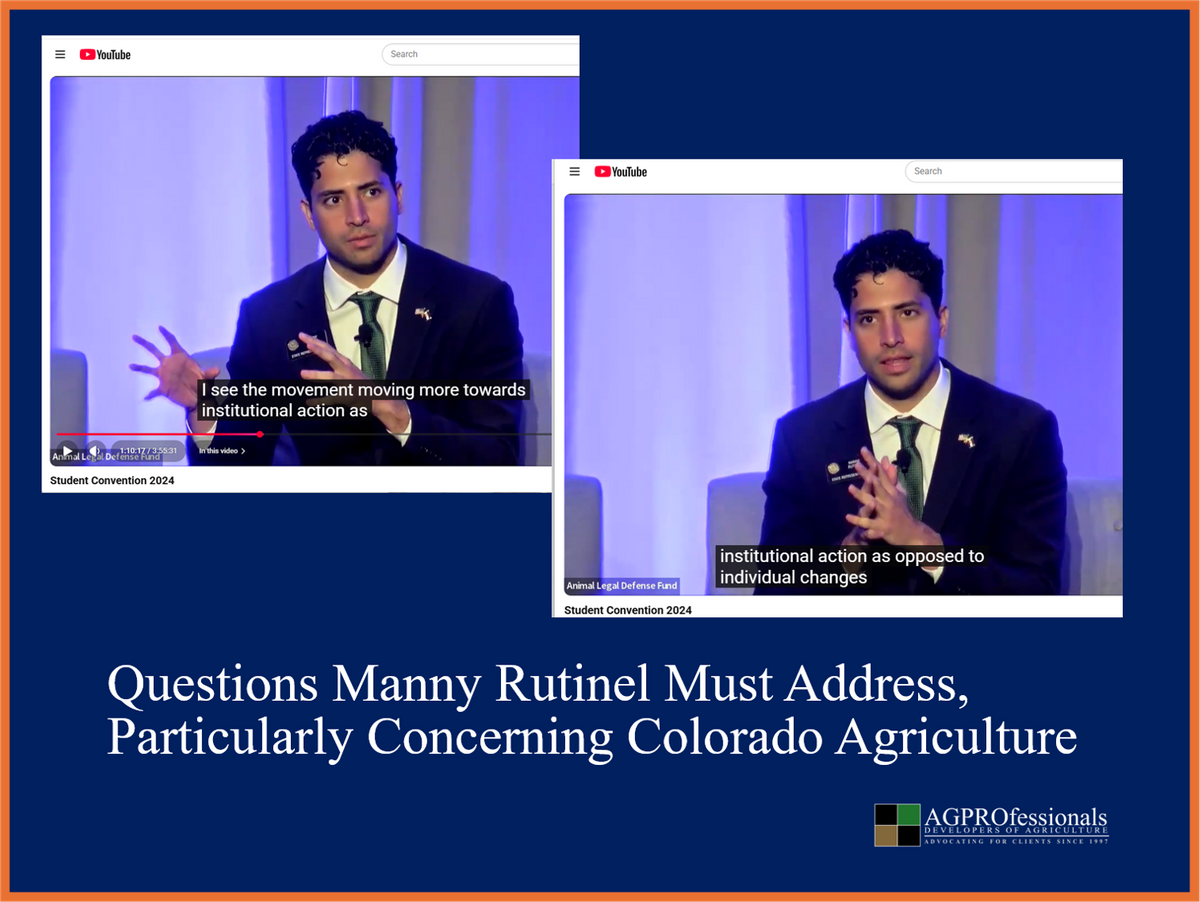
Questions Manny Rutinel Must Address, Particularly Concerning Colorado Agriculture
Manny Rutinel’s animal rights activism history is well-documented, including his work with PETA, Mercy for Animals, Animal Legal Defense Fund (ALDF), The Humane League, HSUS (now Humane World for Animals), and Earthjustice; his Yale law studies; his internship with ALDF; his farm-transition carbon-market proposal; leadership of Climate Refarm; litigation with Earthjustice; and statements at the 2024 ALDF Student Convention.
He has suggested his views are now “nuanced” and no longer fully align with earlier animal-liberation beliefs, also claiming to have stopped being vegan and now eats meat to sample his constituents’ products.
These claims are easy but lack weight without clear policy positions. He must explain his recent activities and his two decades of involvement in the animal rights agenda. Colorado’s farmers, ranchers, dairy producers, livestock feeders, agricultural workers, and meat processors need more than casual reassurances about his changed views. Based on his actions and statements as an appointed State Representative, we remain unconvinced and need to know what he would do if elected to Congress.
Does He Still Support Converting Livestock Farms to Plant Production?
At Yale, Rutinel, a member of the ALDF student chapter, helped develop a proposal to use carbon-offset credits to fund transitions from livestock to plant agriculture. He said the funding could make crop growing more profitable than raising animals. The project’s goal was for carbon registries to adopt this methodology, potentially integrating it into government compliance markets. Even a small share of the offset market could direct hundreds of millions of dollars to converting animal farms to plant-based operations.
- Does he still support his report and proposal?
- If not, when did his position change, and which parts of the program does he now reject?
What is Happening with Climate Refarm?
The Animal Legal Defense Fund identified Rutinel as chief executive of Climate Refarm in its materials for the October 2024 convention.
- What is the Climate Refarm's current status?
- Has Climate Refarm completed or financed any agricultural transition projects? Has it received investments, grants, or carbon-market commitments? Does Rutinel continue to own, manage, or advise the organization?
- Most importantly, does Climate Refarm still support moving farmers away from animal agriculture?
Does He Still Support Proposition 12 as a Model for Forcing the Animal Rights Ideological Agenda?
At the 2024 ALDF convention, Rutinel cited Proposition 12 as proof of institutional power, contrasting voluntary consumer choices with voters' willingness to impose legal production rules, and stated institutional leverage could yield results much greater than individual action.
- Does he still support Proposition 12?
- Would he oppose federal legislation limiting the ability of one state to dictate livestock-production standards for products originating in other states?
- Would he support additional restrictions involving pork, eggs, beef, dairy or poultry?
- Does He Still Support Ballot Initiatives as Leverage Against Agriculture?
Rutinel called California and Massachusetts ballot measures major animal rights victories. He said advocates can use these successes to persuade lawmakers in other states, arguing that agricultural groups would otherwise spend millions fighting likely-to-pass proposals.
- Does he still support this strategy?
- Would he assist animal rights organizations seeking to place agricultural production restrictions on state or local ballots?
- Would he oppose measures protecting lawful livestock and animal businesses from ideologically motivated prohibitions?
- Does He Still Believe Advocates Should Infiltrate Regulatory Agencies to Advance the Animal Rights Ideological Agenda?
Rutinel urged law students to seek careers beyond traditional animal rights groups, citing the EPA as an example. An activist within the agency could promote animal rights by integrating their values into the role.
- Does he still believe federal regulatory employment should be viewed as an avenue for advancing an animal rights ideological agenda?
- How would he ensure that EPA, USDA, and other agencies distinguish sound statutory administration from ideological activism?
- Would he support transparency regarding outside affiliations and conflicts of interest involving agency personnel who participate in coordinated campaigns against regulated agricultural sectors?
Does He Still Believe Animal Rights Activists Should Seek Seats on Agricultural Boards?
Rutinel told the ALDF audience that the public supported animal rights, but this wasn't reflected in legislation. He blamed agricultural committees dominated by rural legislators and “entrenched farm interests" for the gap.
- Does he still hold that view?
- Does he believe that animal rights ideologues deserve a seat at the agricultural table?
- Does he believe that our government agencies should appoint people to their committees who are a clear conflict of interest?
- Does he still believe farmers and ranchers have disproportionate or illegitimate influence over committees responsible for agricultural policy?
- How would those beliefs shape his conduct if assigned to a congressional committee overseeing agriculture, natural resources, the environment or food policy?
Does He Still Believe Animal Rights Activists Should Seek Employment in Meat Companies to Implement Their Ideological Agenda?
Rutinel said his Earthjustice job was to take on large meat corporations and “sue them for all their worth.”
- Does he still believe litigation should be used as a strategic tool against the meat industry?
- How does he distinguish legitimate enforcement of environmental standards from litigation intended to impose costs, disrupt operations or advance a broader campaign against animal agriculture?
- Would he support policies recognizing the economic importance of meat processors and the essential role they play in the food supply?
- Does he believe that employing Trojan Horse tactics against animal product companies is ethical?
- If he knows that employing Trojan Horse tactics against animal product companies is unethical, will he continue to advocate for similar unethical actions with other initiatives?
Rutinel Has Almost Two Decades of Rhetoric Attacking Agriculture, Which Statements Does He No Longer Stand Behind?
Rutinel claims his early Reddit posts don't reflect his current views, but this doesn't address later statements or nearly two decades of campaigning against animal agriculture and promoting his ideological agenda. A clear answer should specify his past beliefs, current stance, and how that change impacts future votes.
- Does he reject his description of animal agriculture as horrific and exploitative?
- Does he reject the goal of transitioning farms away from livestock?
- Does he reject his 2024 institutional strategy?
- Does he reject his comments about agricultural committees and entrenched farm interests?
- Does he reject his characterization of animal agriculture as imposing environmental destruction on the planet?
A Question of Transparency, Not Personal Diet
Manny Rutinel's meat-eating habits are not the main concern. He stated that veganism isn't necessary for animal rights activism and that people can eat animal products while supporting the cause through donations, protests, legal work, political engagement, and institutional influence. He argued that personal veganism alone doesn't lead to policy change.
The Opportunity to Provide Clarity
Obfuscating involves using complex words or vague language to conceal simple truths. Considering the extensive list of questions, this term fits his recent claims of a "nuanced” perspective after almost twenty years of criticizing agriculture. Obfuscation and a reluctance to clearly define his ideological stance leave voters unable to compare his recent campaign promises with his long-standing record.
Colorado's agricultural community deserves to know whether Rutinel has abandoned the government, legal, and economic strategies he has championed for nearly twenty years, rather than just whether he has changed his dinner order.