
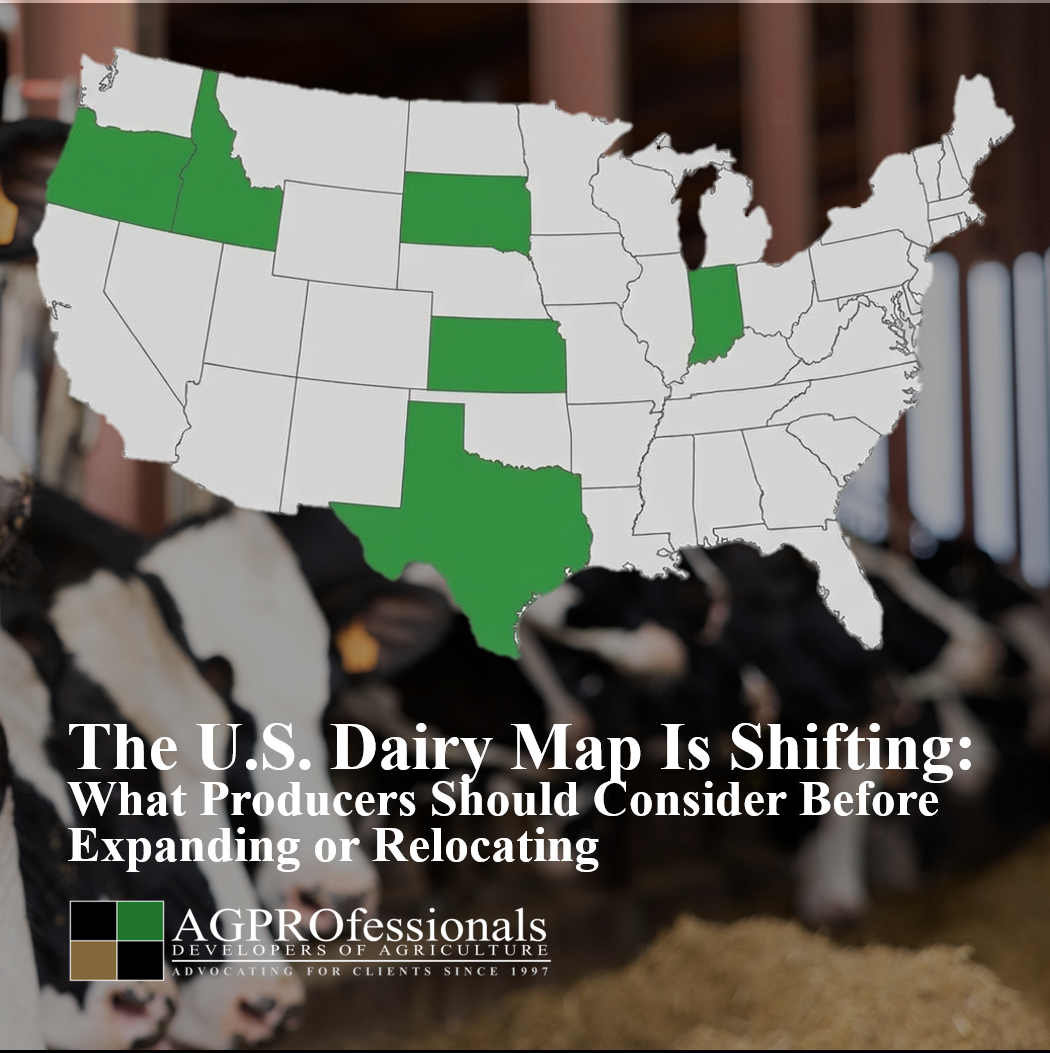
The U.S. Dairy Map Is Shifting: What Producers Should Consider Before Expanding or Relocating
The geography of American dairy production is changing, and the latest USDA numbers show how quickly it's happening. According to USDA's August 2026 milk production estimates, U.S. milk production reached approximately 19.9 billion pounds, up 1.7% since August 2025. The nation's dairy herd increased by about 167,000 cows to 9.71 million head. Notably, milk production per cow was essentially flat, meaning much of the additional milk came from more cows rather than dramatic increases in individual-cow productivity.
Where those cows are being added may be the more important story.
Kansas, Texas and South Dakota Gain Ground
USDA’s NASS September Milk Production report shows:
- Kansas added approximately 29,000 cows compared with a year earlier, while milk production increased 13.9%.
- Texas also added approximately 29,000 cows and increased production by 5.1%.
- South Dakota increased production by 8.4%
- Indiana, Oregon, and Idaho also recorded substantial gains
These numbers reinforce a longer-term trend: dairy production is increasingly gravitating toward regions that offer a combination of available land, feed, processing capacity, infrastructure, and a workable regulatory environment. Kansas illustrates the transformation particularly well. The Kansas Department of Agriculture describes the state as one of the nation's fastest-growing dairy regions, citing land availability, feed supplies, climate, water policy, and its business environment.
Dairy Processing
Billions are flowing into U.S. dairy processing, with CoBank estimating nearly $12 billion in recent investment. In April 2026, Walmart opened a $350 million-plus milk plant in Robinson, Texas, sourcing directly from regional farmers. The investments reinforce one another: processing drives milk demand, dairy expansion supports processors, and both spur growth in feed, transportation, and agriculture. Kansas has also attracted significant processing investment, including Hilmar Cheese Company's more than $600 million facility in Dodge City.
Regulation Belongs in the Location Decision
For producers considering expansion or relocation, land prices and milk markets are only part of the equation. Regulations can significantly affect construction costs, timelines, future expansion, and long-term operating expenses. Compare permitting timelines, zoning, setbacks, water rights and availability, manure storage, Nutrient Management Plans, groundwater monitoring, air-quality obligations, land-application acreage, and requirements for future expansion.
Regulatory certainty and predictability are key:
- Kansas provides a defined livestock waste permitting program through the Kansas Department of Health and Environment. Facilities with an animal-unit capacity of 300 or more generally must register with KDHE, which then determines applicable waste-control and permitting requirements. The state also provides dedicated resources covering livestock waste systems, Nutrient Management Plans, groundwater monitoring, and compliance.
- Texas maintains a CAFO general permit covering qualifying large CAFOs and certain state-only dairy CAFOs. For eligible facilities, a general permit can provide a more standardized regulatory pathway than developing an entirely facility-specific permit, although site conditions, impaired watersheds, and other factors can still trigger individual permitting requirements.
- South Dakota uses a general Water Pollution Control Permit for qualifying CAFOs and publishes a detailed permitting roadmap covering engineering plans, Nutrient Management Plans, and construction requirements.
- Idaho also offers CAFO general permit coverage under its state-administered IPDES program for operations meeting applicable discharge requirements.
Water May Be the Deciding Factor
Water deserves particular attention. A location that appears attractive today may become considerably less attractive if groundwater availability declines, pumping restrictions increase, or water rights cannot support both livestock and feed production. A recent article published in Dairy Herd Management appropriately identifies water as one of the forces reshaping dairy geography. Producers considering relocation should therefore conduct water due diligence alongside environmental and land-use due diligence, not after purchasing property.
AGPROfessionals Can Help Producers Plan the Move Before Buying the Ground
Relocating or expanding a dairy is ultimately a site-selection exercise involving far more than real estate. Water, soils, feed availability, manure utilization, transportation, processing markets, environmental permitting, zoning, engineering, and community considerations all intersect. AGPROfessionals can help producers evaluate those issues before major capital is committed. Our multidisciplinary team provides land-use planning, civil and agricultural engineering, surveying, environmental compliance, CAFO permitting, Nutrient Management Plans, water-related services, agronomy, facility design, construction support, real estate services, and public affairs.
As the dairy map continues to shift, choosing where to build the next generation of dairy facilities may become just as important as deciding how to build them. AGPROfessionals can help producers evaluate potential sites, identify regulatory and infrastructure challenges early, navigate permitting and design, and move a project from initial due diligence through construction and long-term compliance.