
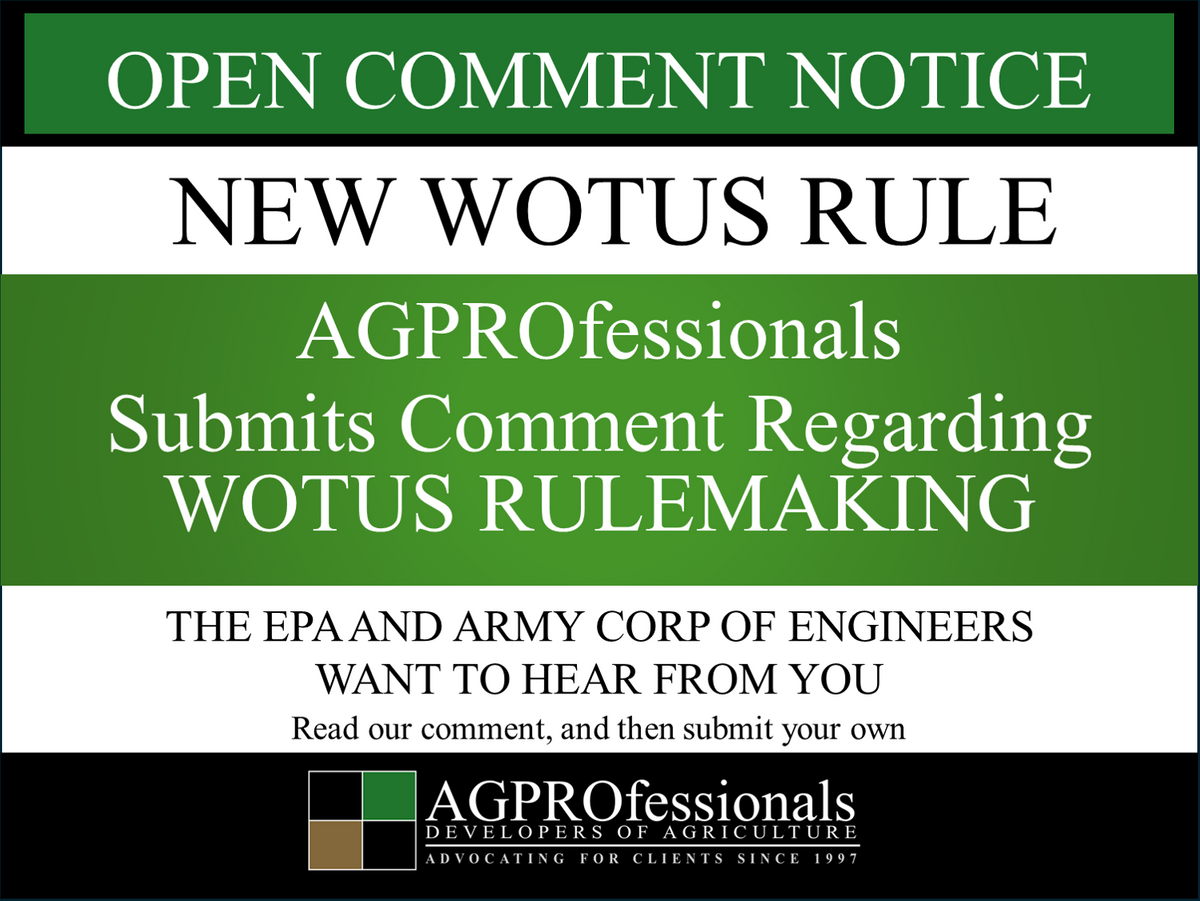
On December 18th, AGPROfessionals submitted a comment to the EPA and Army Corps of Engineers regarding the updated WOTUS rules. Below is the comment submitted.
We encourage producers and producer groups to submit their own comments in support of the updated rules. It is critical that they hear from you.
The comment period ENDS on January 5th, 2026.
The link to submit a comment directly on the Federal website can be found HERE
To read the document details posted on the Federal website, click HERE
To read comments submitted by others, click HERE
AGPROfessionals Comment
Proposed Rule Revising the Definition of “Waters of the United States” (WOTUS). Submitted on behalf of AGPROfessionals and our Agricultural Clients
Date: December 18, 2025
To Whom It May Concern:
AGPROfessionals appreciates the opportunity to comment on the Environmental Protection Agency (EPA) and U.S. Army Corps of Engineers’ proposed rule revising the definition of “waters of the United States” (WOTUS). We support the Agencies’ efforts to bring the rule into alignment with the U.S. Supreme Court’s decision in Sackett v. EPA, which restored necessary constitutional and statutory limits on federal jurisdiction.
Our clients, agricultural producers and property owners across the country, share a strong dedication to clean water, responsible land stewardship, and the long-term health of natural resources. However, for over a decade, changing interpretations of WOTUS have caused regulatory unpredictability and significant risks for landowners engaged in routine agricultural activities. These concerns are not just theoretical. The overly broad definitions in the past exposed producers to severe penalties for normal land management and undermined confidence in federal permitting systems. Agricultural producers cannot afford another cycle of litigation, regulatory rollercoasters, and sudden jurisdictional expansions that are disconnected from congressional intent.
Agricultural producers work on their land daily and must be able to decide, without hiring teams of consultants or attorneys, whether a feature on their property is subject to federal jurisdiction.
Clarity in the rule is essential for:
- Private property rights, a core constitutional protection.
- Regulatory predictability, which allows farmers and ranchers to plan and invest.
- Avoidance of violations, which have historically been arbitrary and carried disproportionate penalties.
The proposed rule represents meaningful progress, and we offer the following recommendations to ensure the final rule is clear, durable, and fully consistent with Sackett, the Clean Water Act, and the Constitution.
Support for Eliminating the Significant Nexus Test and Interstate Wetlands Category
We strongly support the removal of the significant nexus test, which the Supreme Court unanimously held to be unlawful and inconsistent with the structure of the Clean Water Act. We also support the removal of interstate wetlands as an independent jurisdictional category. Sackett makes clear that wetlands cannot be regulated solely based on their geographic location or proximity to state lines. The Agencies’ proposal correctly aligns federal jurisdiction with statutory text and Commerce Clause limits.
The Rule Must More Clearly Define “Relatively Permanent” Waters
In response to the Agencies’ solicitation of comment on the definition of “relatively permanent” in the proposed rule, we submit the following:
While we appreciate the Agencies’ inclusion of several potential definitions for “relatively permanent”, further clarity remains essential. The options listed for the timeframe of “relatively permanent”, even the most stringent, which requires permanent flow during an established “wet season”, still remain regionally unclear and open for interpretation. The EPA’s own presentation found online, “WOTUS Tribal and State Webinar 2: Relatively Permanent Standard”, defines ‘relatively permanent' as:
“The “relatively permanent standard” means relatively permanent, standing or continuously flowing waters connected to paragraph (a)(1) waters, and waters with a continuous surface connection to such relatively permanent waters or to paragraph (a)(1) waters.”
We urge the Agencies to:
- Avoid any language that could allow future reinterpretation, expanding jurisdiction beyond what Sackett permits.
- More explicitly define “relatively permanent” to require standing or continuous, predictable flow, not merely episodic wet conditions, elevated groundwater, or conditions where snowmelt or water management efforts cause water flow. Our recommendation for the best approach, which would eliminate the opportunity for arbitrary regulation, is to focus on the word “permanent” and to institute a “continuous, predictable flow” requirement for permanent, standing, or continuously flowing waters, as the EPA has stated.
Support for the “Continuous Surface Connection” Standard, With Needed Precision
The Agencies’ March 12, 2025, guidance correctly instructs field staff to treat “continuous surface connection” as requiring physical abutment, not intermittent flow, not subsurface hydrology, and not adjacency based on proximity. We urge EPA and the Corps to:
- Codify this guidance in regulatory text, rather than relying on interpretive memoranda, for example, “Memorandum to the Field Between the U.S. Department of the Army, U.S. Army Corps of Engineers and the Environmental Protection Agency Concerning the Proper Implementation of 'Continuous Surface Connection…”, which states:
“First, the adjacent body of water must be a “water of the United States,” which generally means traditional navigable waters, or a relatively permanent body of water connected to a traditional navigable water. Second, the wetland, assuming it satisfies the agencies’ longstanding regulatory definition of “wetlands” at 33 C.F.R. 328.3 and 40 C.F.R. 120.2, must have a continuous surface connection to a requisite covered water making it difficult to determine where the water ends and wetland begins.”
- Remove the clause, “at least during the wet season”, as this creates an opportunity for further reinterpretation and expanding jurisdiction beyond what Sackett permits as listed above.
- Make clear that berms, levees, dikes, irrigation features, and naturally occurring breaks constitute clear separation, not jurisdiction.
Support for Revised Definitions of Ditches, Prior Converted Cropland, and Groundwater Exclusion
Ephemeral drainages, temporary pools of water in landscape depressions on farmland after a period of rain, or during the “wet season”, also known as “vernal pools”, temporary pools of water, low-volume desert washes, precipitation-driven features, and short-duration flows are widespread across agricultural landscapes and must be categorically excluded.
Agriculture relies heavily on constructed conveyances, drainage systems, and previously converted cropland designations. We therefore strongly support the following exclusions, which are essential for predictable land management and responsible water stewardship:
- A firm ditch exclusion, especially for ditches constructed in uplands or used for irrigation, stormwater management, field drainage, and wastewater systems.
- A strengthened and durable prior converted cropland definition implemented consistently and without shifting “abandonment” tests that have historically created uncertainty.
- The new groundwater exclusion, which aligns with Sackett and decades of precedent.
Avoid Case-by-Case Jurisdiction Tests That Recreate Prior Uncertainty
Producers must be able to determine jurisdiction without lawyers or consultants. Case-specific tests, no matter how well-intentioned, invite inconsistent application across districts and regions.
We urge the Agencies to:
- Rely exclusively on objective, bright-line criteria.
- Avoid any “professional judgment” standards that function as a de facto significant nexus test.
- Ensure that ephemeral features, isolated depressions, playa lakes, and stormwater conveyances are categorically excluded.
Conclusion
Clean water and clear rules are not competing priorities; they depend on one another. Farmers, ranchers, and landowners invest daily in soil health, water quality, and stewardship. What they need from the federal government is a WOTUS definition that is:
- Clear
- Constitutional
- Durable
- Fully consistent with Sackett
AGPROfessionals urges the Agencies to finalize a rule that restores certainty, respects private property, aligns with congressional intent, and enables producers to continue feeding the nation while protecting natural resources.
Thank you for the opportunity to comment.
____________________________________________________________________
Additional Links
EPA website link to updated definition of WOTUS HERE
Public Fact Sheet produced by the EPA HERE
Guidance memorandum between the Army Corps of Engineers and the Environmental Protection Agency (EPA) HERE
Updated definition of WOTUS on the Federal Register HERE
AGPROfessionals Article about the new WOTUS rules, "EPA 2025 WOTUS Revision: What Farmers, Ranchers and Land Owners Should Know" HERE
American Farm Bureau Federation (AFBF) WOTUS information HERE
Article by a law firm Van Ness Feldmen, "EPA and Corps Navigate New Regulatory Definition of Waters of the United States" HERE
Article in Western Livestock Journal HERE