
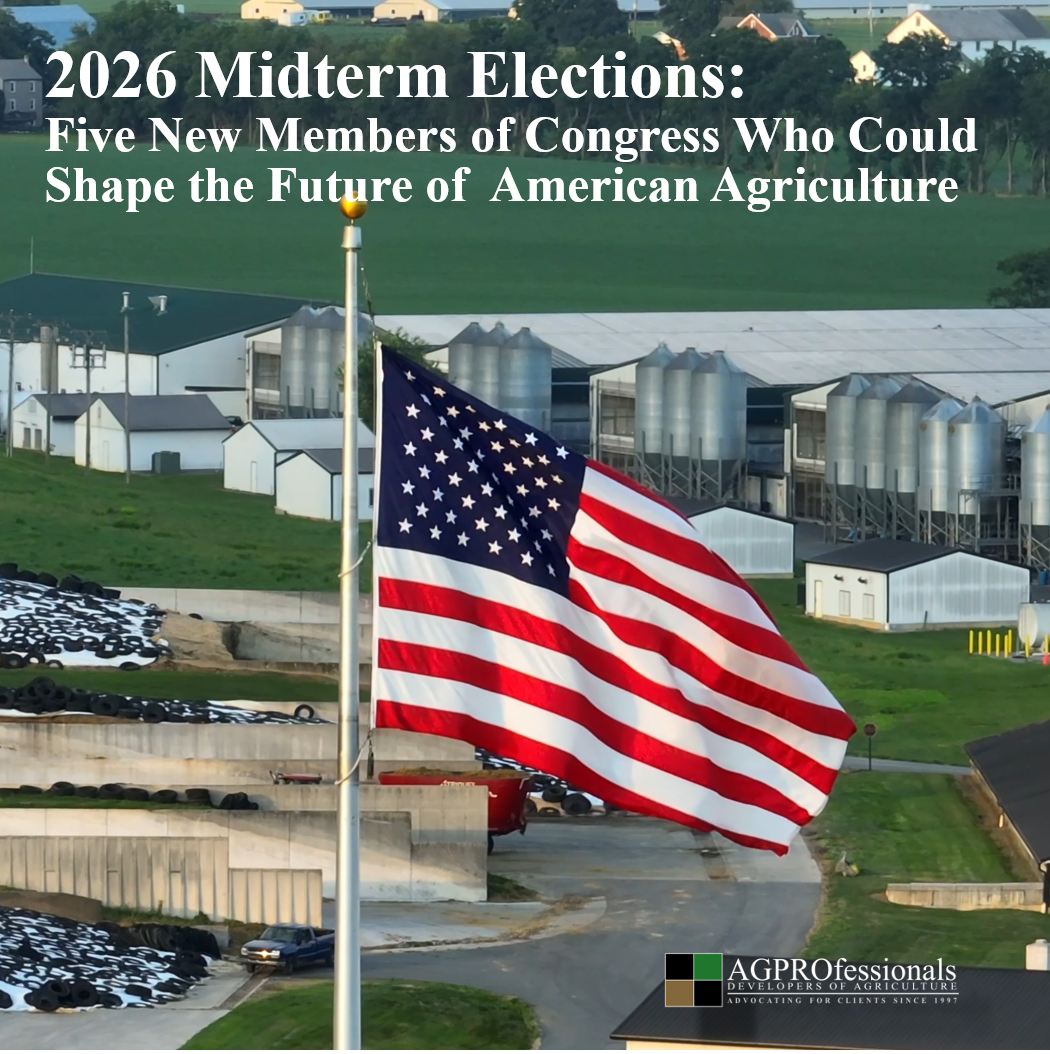
2026 Midterm Elections: Five New Members of Congress Who Could Shape the Future of American Agriculture
The November 3, 2026, midterm elections have brought new faces to Congress, including lawmakers whose positions on agriculture could significantly affect American farmers, ranchers, dairy producers, and livestock operations. For AGPROfessionals, the election raises an important question: Will incoming lawmakers support the large modern farms essential to America's food supply, or pursue policies that make agricultural production more difficult and more expensive?
Many candidates campaign on supporting what they call “family farms,” but that commitment may not extend to larger agricultural operations, even though 95% of all farms are, in fact, family farms. This distinction is essential as Congress prepares to address the Farm Bill, agricultural regulations, private property rights, and domestic food production. Below, we provide information on five new lawmakers who could affect the future of American agriculture.
Chris McGowan: Agricultural Markets and Property Rights
Republican Chris McGowan, elected to represent Iowa's 4th Congressional District, comes from a key agricultural region. A fourth-generation Iowan with deep rural ties, he says supporting agriculture means protecting markets and landowner rights and pursuing fair-trade agreements. He supports year-round E15 sales, expanded markets, and investment in value-added agriculture. He opposes federal limits on private-equity farmland purchases, asking during an October debate whether the government should stop farm families from selling to willing buyers. He also supports improving access to capital for beginning farmers.
Rebecca Cooke: Supporting Small Farms While Challenging Agriculture
Democrat Rebecca Cooke, elected in Wisconsin's 3rd Congressional District, grew up on a dairy farm and has firsthand experience with agricultural production. However, her agricultural platform clearly distinguishes between smaller farms and larger agricultural businesses. Cooke has proposed directing more federal tax incentives and subsidies to small and midsize farms, increasing antitrust enforcement against large agricultural corporations, and restructuring the Farm Bill to prioritize smaller producers. She has also called for expanded agricultural exports and stronger market competition. Importantly, her stated preference for redirecting federal agricultural support to smaller operations raises questions about how her policies could affect larger dairies and livestock producers.
Jamie Ager: A Joel Salatin Protege
North Carolina's newly elected Democratic Congressman Jamie Ager trained under Joel Salatin and embraces Salatin's philosophies. He owns Hickory Nut Gap, a meat production business that emphasizes pasture-based livestock and regional agricultural markets. His agricultural priorities include supporting beginning farmers, expanding market opportunities for small producers, strengthening agricultural landownership, and establishing right-to-repair protections for farm equipment. Ager's emphasis on smaller agricultural businesses, combined with Salatin's rejection of large modern farming systems, makes his approach to large modern livestock operations an important area to monitor. His legislative positions will help determine whether he supports production systems of different sizes and management practices.
Lindsay James: Critical of Modern Farming Systems
Democrat Lindsay James, elected to represent Iowa's 2nd Congressional District, has expressed interest in joining the House Agriculture Committee. As a former Iowa State Representative, James has been an outspoken critic of larger modern farming systems and environmental permitting. She has identified passage of a Farm Bill as a priority and acknowledged the financial pressures facing producers, including rising fuel, fertilizer, and other input costs. She has also expressed interest in transportation and infrastructure policy, which directly affects agricultural commerce. Given Iowa's substantial livestock and grain production, her approach to federal agricultural regulations, market access, and farm economics deserves attention.
Randy Villegas: Critical of Modern Farming Systems
Democrat Randy Villegas was strongly endorsed by environmental groups focused on larger modern farms. Villegas defeated Republican David Valadao in California's 22nd Congressional District, replacing a lawmaker with firsthand dairy-farming experience. The district includes agricultural communities facing substantial challenges with water availability, production costs, labor, and environmental regulation. Villegas has advocated accelerating environmental reviews. He has also criticized trade policies he believes raise costs for farmers and ranchers. These positions address important agricultural concerns. However, questions remain about his approach to California's heavily regulated dairy and livestock industries, including CAFO permitting, water-use restrictions, and environmental compliance. His future legislative record will determine how his stated agricultural priorities translate into policy.
Modern Agriculture Needs Representation That Understands Production
America's agricultural industry includes farms of every size, but larger, modern operations play an essential role in producing affordable food for a nation of more than 340 million people. Modern farms operate under extensive regulatory frameworks covering environmental protection, animal health and wellbeing, water quality, and food safety.
At AGPROfessionals, we believe agricultural policy should recognize the importance of these operations rather than penalize producers simply because of their size. As the 120th Congress convenes in January 2027, we will continue to monitor lawmakers' positions on agricultural regulations, property rights, water access, and livestock production. Supporting American agriculture must mean supporting farmers' and ranchers' ability to produce food efficiently, responsibly, and at the scale necessary to meet America's needs. That principle should remain central to agricultural policy, regardless of political party.