
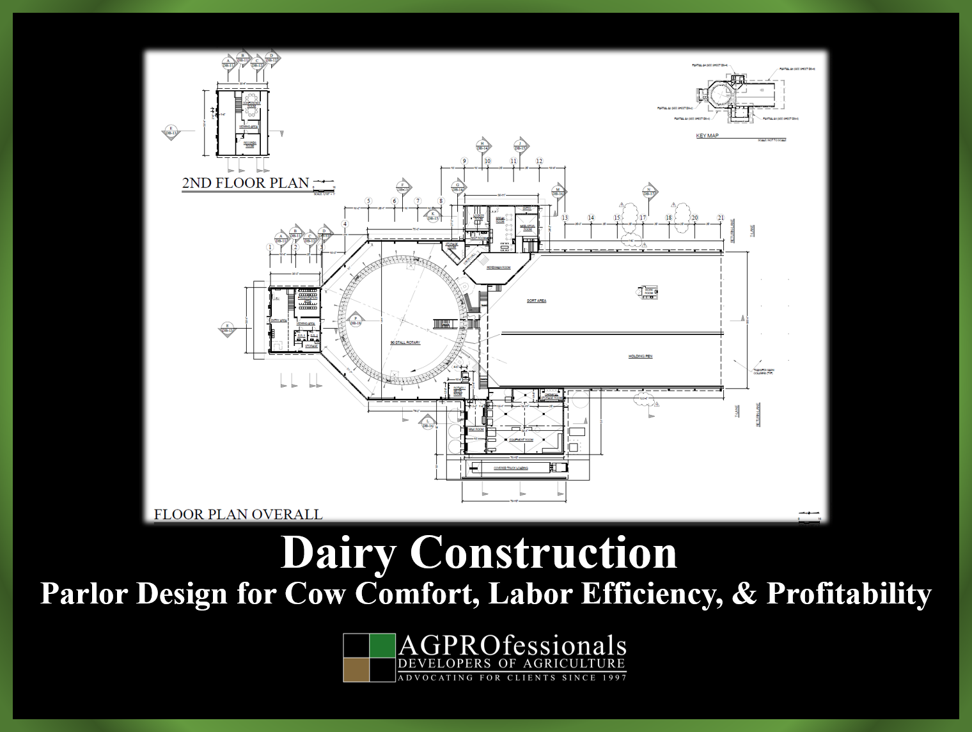
Planning a new dairy facility is a significant investment for any dairy operation. Whether it’s designed for 1,000 or 10,000 cows, the choices made during planning will impact labor efficiency, cow comfort, milk production, and long-term profitability. A key focus in modern dairy design is the milking center. While many producers focus on parlor capacity and size, the most successful facilities start by asking: How can the design prioritize the cow's needs?
Facility Layout Matters More Than Ever
As dairy operations continue to expand, facility layout has become one of the most important drivers of operational efficiency. Older dairy designs often relied on T-shaped or H-shaped layouts with naturally ventilated barns. While effective for smaller operations, these designs can require cows to travel longer distances as herd sizes increase. New dairy construction projects increasingly utilize cross-ventilated and tunnel-ventilated barn designs that position rotary parlors centrally within the facility. This approach reduces walking distances, shortens time away from pens, and improves overall cow flow.
Many modern large-scale dairies use dual rotary parlors located between large cross-ventilated barns, creating a more efficient system that keeps cows closer to the milking center while supporting high production and animal welfare. These designs also come with a hefty price tag per cow, so the economics must also be considered.
The large increase in cow values and heifer costs has brought with it a need to look at replacement costs and the health and longevity of cows. Cows that live and operate at a high level for longer will reduce your replacement costs.
Adequate Rest for Cows Impacts Milk Production
Research consistently shows that cow comfort directly influences milk yield and herd performance. A key aspect in designing dairy facilities is ensuring cows get enough rest. Industry standards recommend at least 12 hours of lying down each day, along with enough time for feeding, drinking, and moving freely across the facility. As dairies expand, one major challenge is reducing the time cows spend away from their pens.
Walking to and from the parlor, waiting in holding areas, and milking can significantly cut into rest and feeding time. Consequently, many dairy design experts advise limiting combined walking and milking time to no more than three hours daily, regardless of how often cows are milked. This guideline helps maintain cow comfort while supporting optimal milk production and herd health.
Choosing the Right Rotary Parlor Size
Rotary parlors have become a popular choice for large-scale dairy farms because of their labor efficiency, steady cow movement, and ability to incorporate advanced technologies and automation. Modern rotary systems usually feature 40 to 100 stalls, offering several benefits over traditional parallel and herringbone setups. Their continuous-flow design improves labor utilization, simplifies employee tasks, and reduces delays during cow loading and unloading.
Interestingly, larger rotary parlors do not always significantly increase throughput; when attachment speed is the bottleneck, a 72-, 80-, or 100-stall rotary can each manage around 720 cows per hour in typical conditions. This insight explains the rising popularity of the 80-stall rotary, which many dairy designers now see as an optimal balance between efficiency and practicality. The downside is that they are not easily expandable. You can’t expand the rotary without stopping milking to remodel the dairy barn.
Throughput Alone Does Not Determine Success
While hourly cow throughput is a key metric, it shouldn't be the only factor in choosing a parlor. Dairy owners need to consider how capacity aligns with herd size, milking routines, labor resources, and their facility layout. Ultimately, successful dairy operations balance production objectives with practical factors like cow traffic, worker efficiency, maintenance needs, economics, and options for future growth.
Planning for Long-Term Dairy Success
When investing in a new dairy facility, the goal should be more than simply building enough parlor capacity to milk today's herd. Successful dairy construction projects account for future growth, labor availability, technological advancements, and the evolving expectations of both cows and employees.
By prioritizing cow comfort, minimizing time away from the pen, optimizing facility layout, and selecting the right parlor design, dairy producers can create operations that deliver stronger performance, greater efficiency, and improved profitability for years to come.
At AGPROfessionals, we understand that every dairy operation has unique goals, challenges, opportunities, and economics. Whether you're evaluating a new dairy construction project, planning an expansion, or preparing for the next generation of growth, our team can help you assess the factors that influence long-term success and return on investment.
RELATED ARTICLES:
What to Think About When Expanding Your Dairy Operation
Preparing for the Next Generation: Dairy Facility Improvements that Add Long-Term Value