
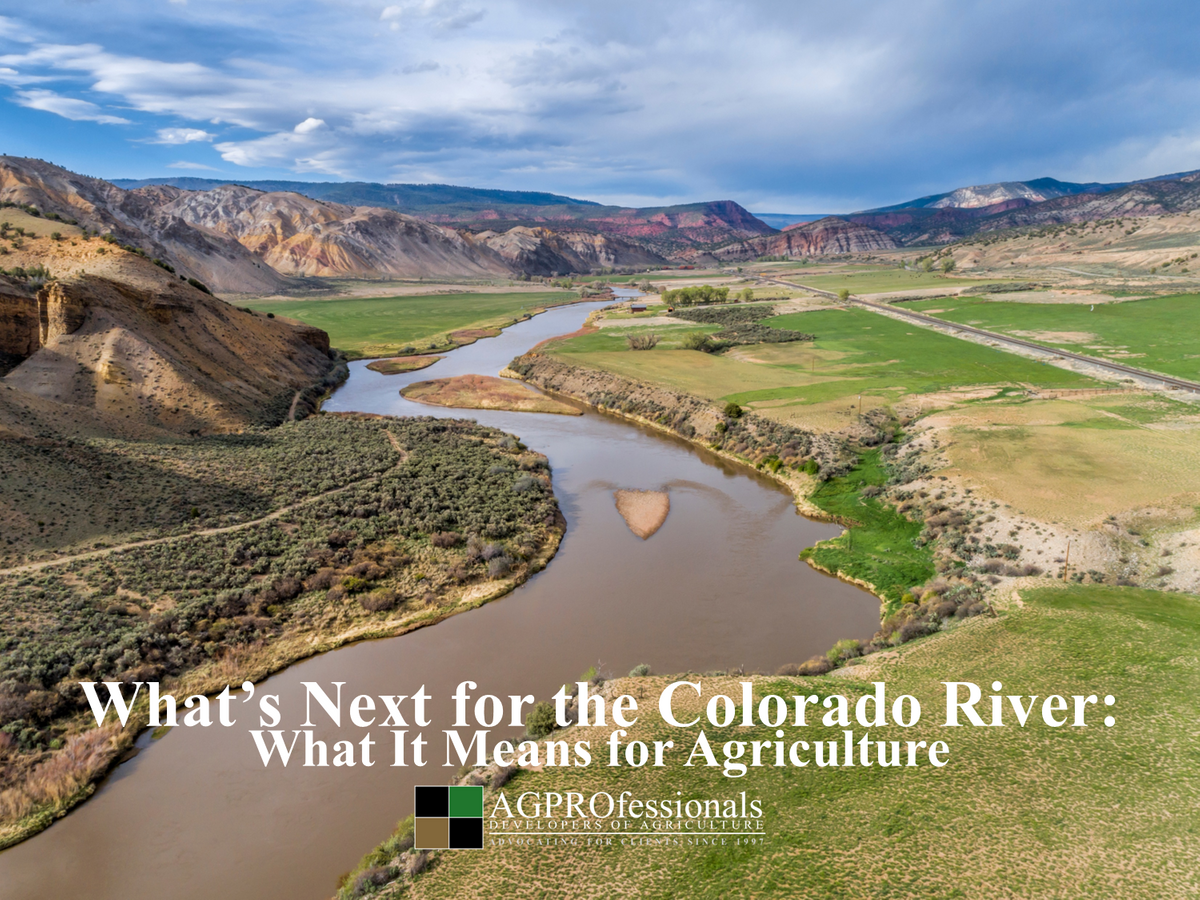
The Colorado River is the lifeline of their operations for agricultural producers across the West. It irrigates approximately 5.5 million acres of farmland and supports rural communities across seven states.
As the current federal management guidelines are set to expire in 2026, decisions being made right now will shape the future of Western agriculture for decades. Here’s a look at what’s happening and how those decisions could impact agricultural producers going forward.
The Foundation: The Colorado River Compact
Management of the river starts with the Colorado River Compact of 1922, which divided the river among:
- Upper Basin States: Colorado, New Mexico, Utah, Wyoming
- Lower Basin States: Arizona, California, Nevada
1922 was an exceptionally wet year, and writers of the Compact expected the Colorado River to produce 16.5 million acre-feet (MAF) of water. Each basin was allocated 7.5 million acre-feet (MAF) of water annually, with the Lower Basin given permission to use an extra 1 MAF. Today, the river produces closer to 12.4 MAF annually, which is well below the 16.5 MAF expected in 1922. In other words, more water was promised than the river generally supplies.
The current system was built for a river that no longer exists. As the National Agricultural Law Center explains, the Compact overestimated long-term supplies, and modern drought conditions are forcing structural changes. This is about more than policy for agricultural producers; water reliability directly impacts long-term agricultural investments.
Current Rules and Why They’re Expiring
The main dispute between the Upper (CO, UT, WY, NM) and Lower (CA, AZ, NV) centers concerns who should shoulder the responsibility for mandatory water reductions during severe shortages. Since 2007, the river has been managed under the Colorado River Interim Guidelines, which established shortage tiers mainly based on Lake Mead’s elevation. In 2019, states adopted a Drought Contingency Plan (DCP) to introduce additional conservation measures. In 2023, Lower Basin states agreed to conserve 3 MAF before 2026, with federal compensation covering 2.3 MAF. However, these guidelines will expire in 2026, and the seven basin states have not yet agreed on a unified plan moving forward.
In 2024, Upper and Lower Basin states submitted separate proposals to the Bureau of Reclamation.
Lower Basin Proposal
- Shortages triggered by total basin storage, not just Lake Mead
- Both basins would share conservation responsibilities
- Average reductions of about 1.5 MAF under most conditions
Upper Basin Proposal
- Shortages tied to combined levels of Lake Mead and Lake Powell
- Releases from Lake Powell are reduced during low storage years
- Could result in less water flowing downstream than historical expectations
Federal Involvement: What Happens If States Don’t Agree?
If the states cannot reach an agreement, the Bureau of Reclamation has stated it will act unilaterally. A formal federal review under the National Environmental Policy Act (NEPA) is underway. Reclamation has proposed five management options:
- No Action - Revert to pre-2007 rules
- Federal Authorities - Shortages based solely on federal statutory authority
- Federal Authorities Hybrid – Basin-wide proportional shortages and possible conservation storage pools
- Cooperative Conservation - Incentivized conservation and environmental stewardship
- Basin Hybrid - Combines state proposals, allowing priority-based or proportional shortages.
What This Means for Agricultural Producers
Agriculture uses about 52% of Colorado River water for irrigation. This makes producers central to every conservation debate. Meanwhile, municipal demand continues to grow in cities like Phoenix, Las Vegas, and Los Angeles. The combined effect of increasing urban use and ongoing drought has driven Lake Mead and Lake Powell to historically low levels. From an agricultural perspective, several key realities emerge:
Reductions Are Probable
Nearly all proposals include basin-wide conservation triggers, meaning agriculture will likely bear a significant share of the cuts.
Compensation May Persist but Is Not Assured
Recent agreements feature federal payments for voluntary conservation efforts. However, long-term funding remains uncertain and depends on congressional approval.
Priority Rights Still Hold Significance
Under the “Law of the River,” priority systems stay crucial. According to the Congressional Research Service Report, “Management of the Colorado River: Water Allocations, Drought, and the Federal Role” (R45546), western water law largely follows a prior appropriation system, “first in time, first in right.” Senior agricultural rights in certain regions offer vital protections, although interstate agreements complicate the sharing of shortages.
Federal Authority Is Growing
The federal government manages major infrastructure like the Hoover Dam and the Glen Canyon Dam, and is increasingly positioned to influence basin-wide outcomes if states are unable to reach consensus.
Where Agriculture Must Lead
The Colorado River feeds cities, but it also feeds the nation.
The decisions made in 2026 will determine whether agriculture stays viable in Colorado River basin states.
As negotiations continue, agricultural producers have both an opportunity and a responsibility to participate:
- Advocate for recognition of senior water rights, “first in time, first in rights.”
- Ensure food production remains a national priority in water allocation decisions.
- Support voluntary, paid conservation mechanisms.
- Push for fair burden-sharing between urban and agricultural users.
Links
Colorado River Compact (1922) HERE
Congressional Research Service Report R45546: Management of the Colorado River: Water Allocations, Drought, and the Federal Role HERE
National Agricultural Law Center – Water Law Resources: HERE